
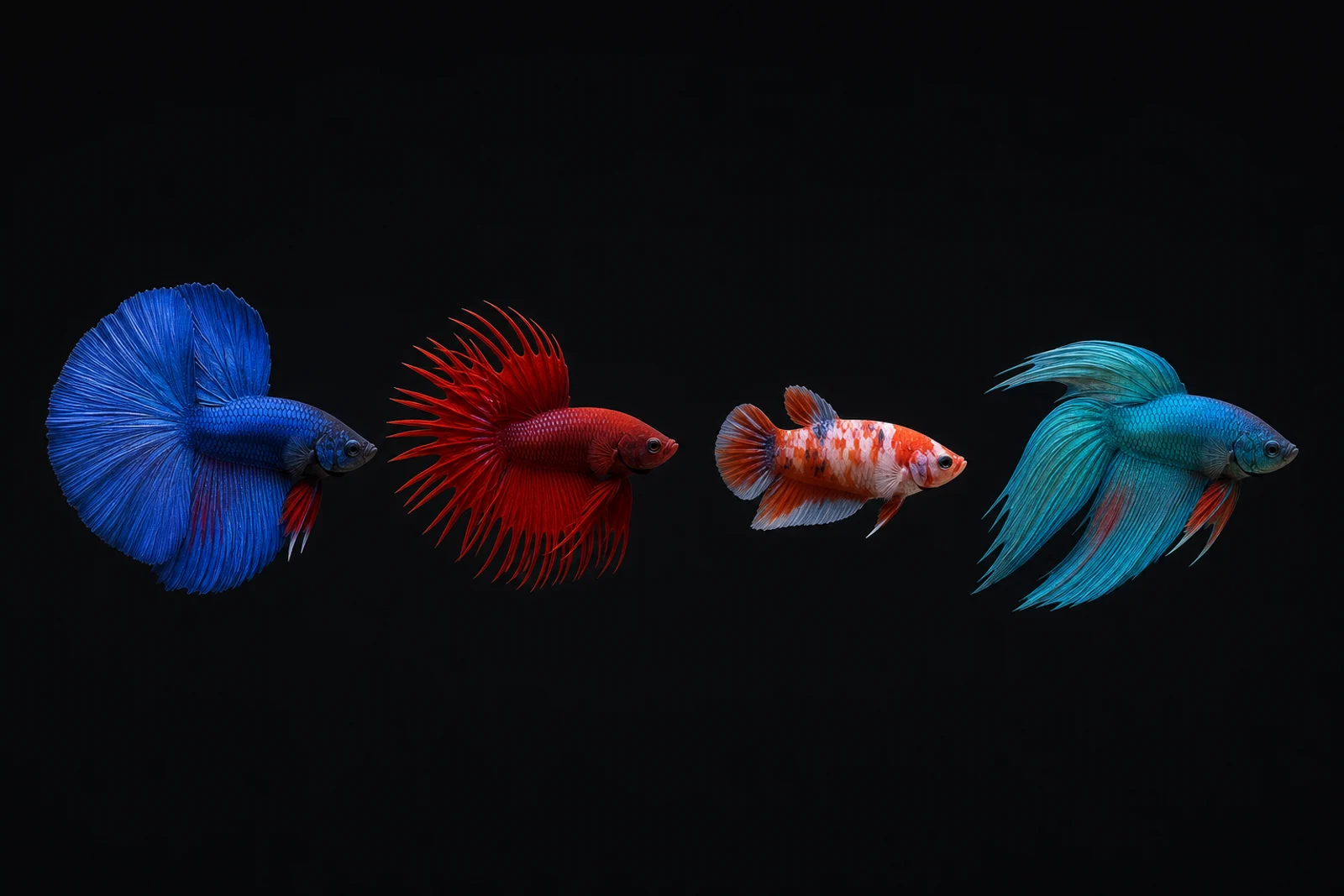
Bettas are sold by the shape of their fins. That is the whole basis of the naming system, and it is worth knowing what the names mean before you pay a premium for one.
What matters less than the shop suggests: none of these types needs different water, different food or a different tank. What matters more: heavy finnage has real consequences for how a fish moves.
Tail shapes
| Type | What it looks like | Worth knowing |
|---|---|---|
| Veiltail | Long fin sweeping down in a single curve | Most common, least expensive, entirely fine |
| Halfmoon | Caudal opens to a smooth 180 degree semicircle | Heavy. Tires in current, tears on sharp decor |
| Delta | Triangular, opening less than 180 degrees | Super delta sits between delta and halfmoon |
| Crowntail | Webbing recedes so the rays spike outward | Spectacular, and the exposed rays damage easily |
| Plakat | Short fins, compact body | The strongest swimmer of the group |
| Double tail | Caudal split into two distinct lobes | Often a shorter body, sometimes with swim issues |
| Elephant ear | Enlarged pectoral fins that flap like ears | Also sold as dumbo. The pectorals add drag |
| Giant | Any tail type on a much larger fish | Needs ten gallons rather than five |
Long fins have a cost
A halfmoon or crowntail is carrying a lot of surface area. In practice:
They tire in flow that a plakat would swim through without noticing, so baffle your filter. They snag on plastic plants and sharp ornaments, which is why silk is worth the swap. And a heavy caudal can weigh a fish down as it ages, so an older long-finned betta resting more is not automatically ill.
None of that makes them a bad choice. It just means the tank has to suit the fish you bought.
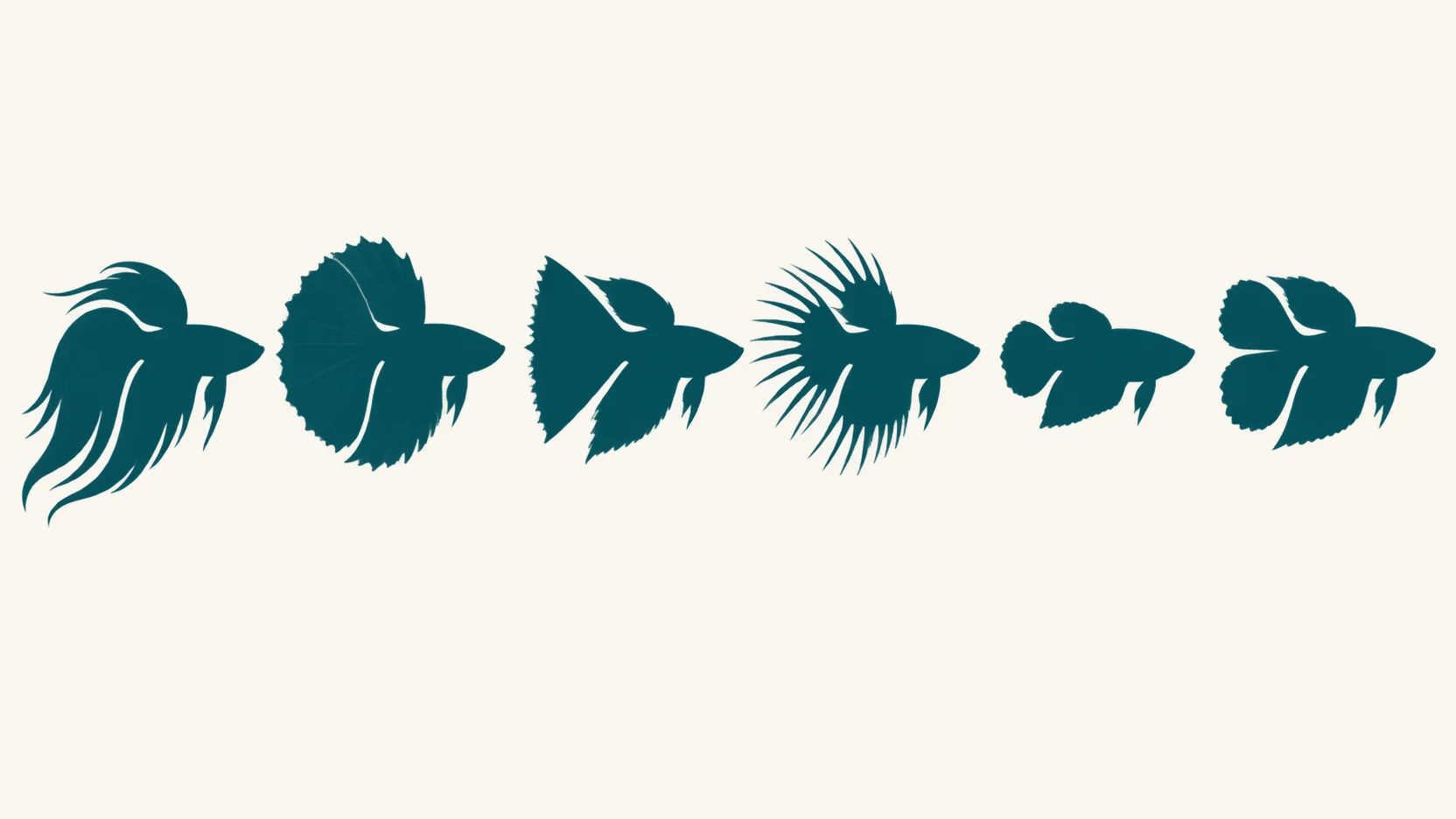
- Veiltail
- Halfmoon
- Delta
- Crowntail
- Plakat
- Double tail
Colours and patterns
Colour naming is looser than tail naming, and a good deal of it is marketing.
| Pattern | What it means |
|---|---|
| Solid | One colour across body and fins. Red, blue, black, white, yellow |
| Bi-colour | Body and fins differ. Most of the striking red and blue fish |
| Butterfly | Colour band on the body, pale outer edge to the fins |
| Marble | Pigment keeps rearranging through life. The fish will change |
| Koi | Marble selected for orange, red, white and black patches |
| Dragonscale | Thick metallic scaling. Occasionally overgrows the eye |
| Galaxy and similar | Usually a breeder’s label rather than distinct genetics |
Marble is the one to understand before buying. Marbles carry a gene that keeps moving pigment around, so the fish you take home is not the fish you will have in a year. One that goes from mostly white to mostly blue is behaving normally.
Dragonscale is worth a second thought too. The scaling that makes it look superb can grow over the eye, and that is not something you can undo.
Colour change is not always cosmetic
A marble shifting pattern is normal. A fish losing colour while clamping its fins, sitting on the bottom or refusing food is not, and the first thing to do is test the water rather than look up patterns.
Male and female
Males have the long fins, the stronger colour and the reputation. Females are shorter-finned and were traditionally duller, though breeding has closed much of that gap.
The dangerous myth here is not about colour. It is that females are peaceful. They are not reliably peaceful with each other, and a sorority is a demanding setup rather than a beginner one. Two males cannot be housed together at all, under any circumstances, in any size of tank.
Does the type change the care?
Almost never. Every betta on this page needs the same things:
At least five gallons, and ten if it is a giant. Water held at 25 to 28 °C. A cycled tank with a gentle filter. A carnivore diet in small portions. A lid, because all of them jump.
The adjustments that do follow from type are small: baffle the flow harder for long-finned fish, choose silk over plastic, and go up a tank size for a giant.
Choosing one
Buy the fish that looks alert rather than the fish with the best fins. Fins are the thing shops price on, and a listless halfmoon is a worse purchase than a bright veiltail every time.
Look for fins carried open rather than clamped, even colour with no white patches or fuzz, clear eyes, and a fish that reacts when you approach the cup. Ragged fin edges may be fin rot or may be damage from the cup, and you cannot always tell which from the outside.
Where to go next
Whichever type you pick, the requirements are the same, and tank size is the one most often got wrong.