
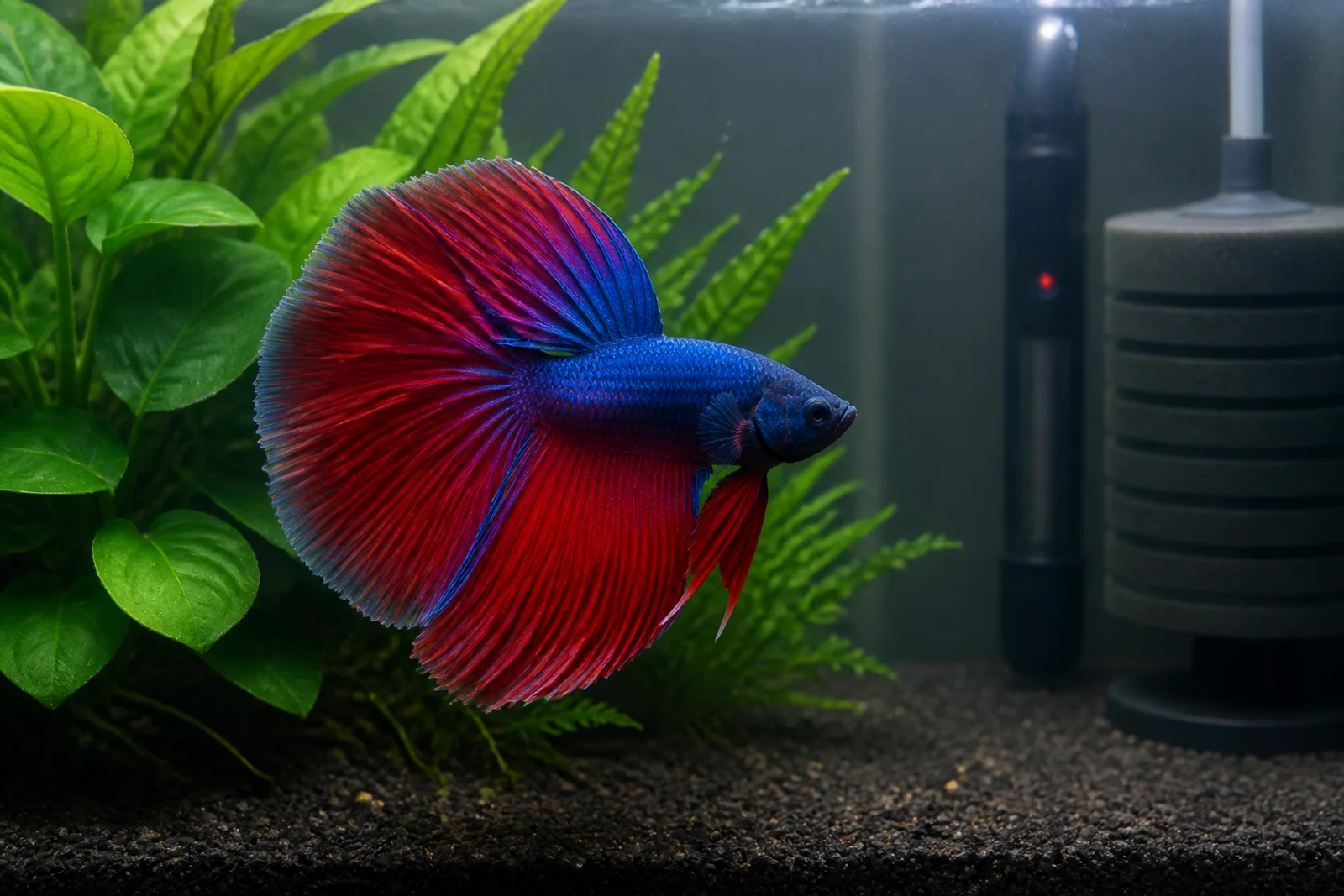
Most betta guides start with how charming the fish are. This one starts with the part that actually decides whether yours lives: five gallons, a heater, a filter, and cycled water.
Get those four right and a betta is genuinely easy to keep. Get them wrong and you will spend months troubleshooting a fish that was never given a chance. Almost everything sold as a “betta kit” gets at least two of them wrong.
What a betta actually is
Bettas are tropical freshwater fish from Thailand and neighbouring parts of Southeast Asia, related to gouramis. Wild bettas live in shallow, slow-moving, warm water: rice paddies, floodplains and canals.
Two facts from that habitat get misused constantly.
They have a labyrinth organ, so they can breathe air from the surface. This is an adaptation to low-oxygen water. It does not make small or dirty water safe, because breathing air does nothing about ammonia or temperature.
Their habitat is shallow, which gets repeated as “they live in puddles”. A rice paddy is shallow and enormous, connected to other water and constantly refreshed. It is a very large volume that happens not to be deep.
The four things that matter
1. Volume: five gallons minimum
Below five gallons, waste concentrates and temperature swings faster than you can correct. The RSPCA recommends 20 litres or more, with 10 litres as an absolute minimum, alongside filtration, heating and planting.
Ten gallons is easier than five, not harder. More water dilutes mistakes.
2. Heat: 25 to 28 °C, steady
Bettas are tropical. Room temperature is not tropical, and a fish riding your heating cycle up and down every day is a fish with a suppressed immune system.
Use an adjustable heater and a separate thermometer. Do not trust a preset heater or the heater’s own dial. Stability matters more than hitting an exact number.
3. Filtration and the nitrogen cycle
Your fish produces ammonia constantly. Ammonia burns gills and fins and kills well before it is visible.
In a cycled tank, bacteria convert ammonia to nitrite, then nitrite to far less harmful nitrate, which you export with water changes. Those bacteria live mostly in your filter.
A cycled tank reads zero ammonia, zero nitrite, and some nitrate. Getting there takes several weeks and is the single most valuable thing you can do before buying a fish.
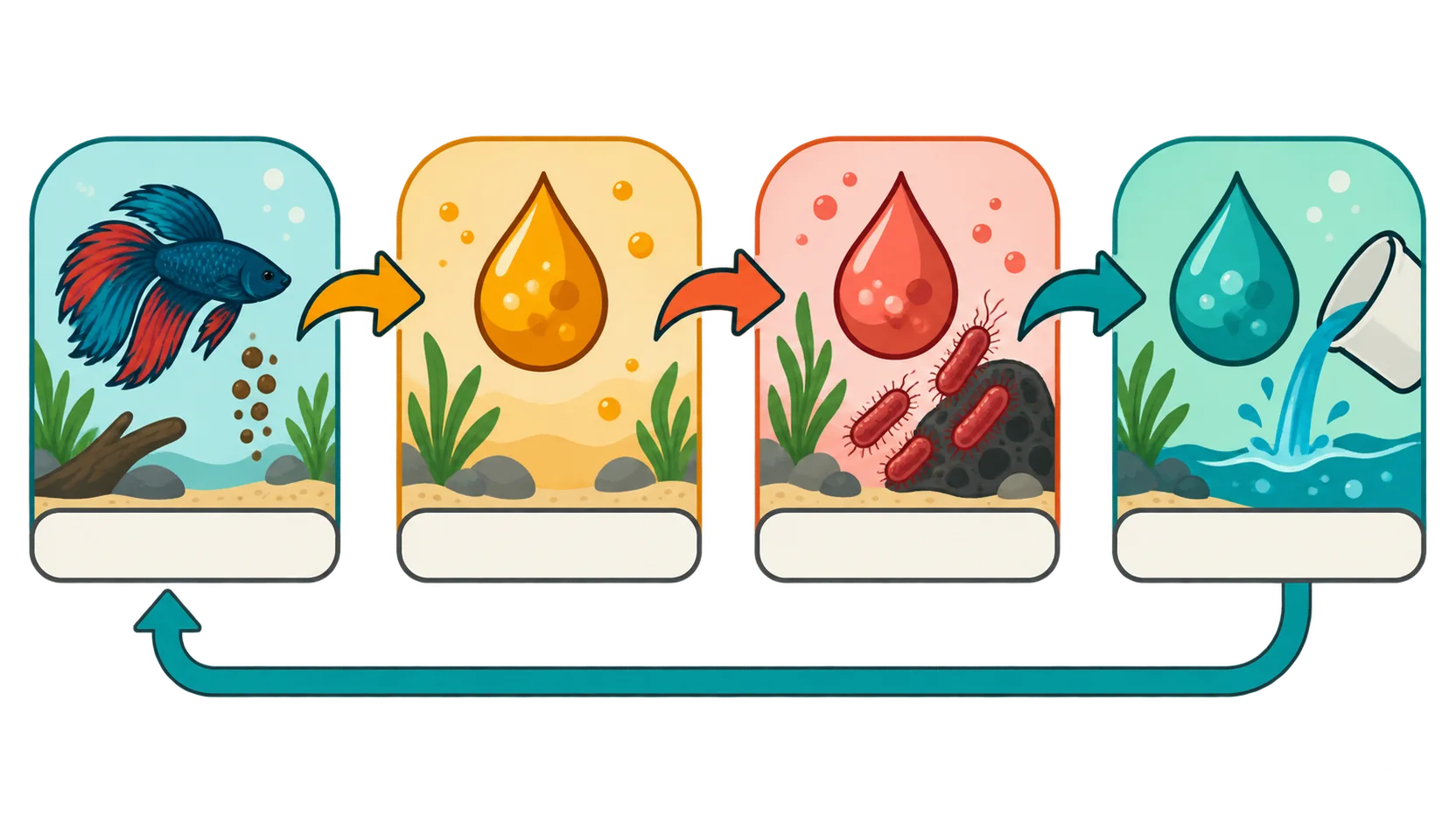
- Fish waste
- Ammonia
- Nitrite
- Nitrate removed
Bettas are weak swimmers with heavy fins, so keep flow gentle. A sponge filter is ideal. If you use a hang-on-back filter, baffle the outflow.
4. Water changes
In a cycled five to ten gallon, about 25% weekly. Dechlorinate it and match the temperature before it goes in.
Never do a full water change and never wash your filter media in tap water. Both destroy the bacterial colony you spent weeks growing.
Setting up, in order
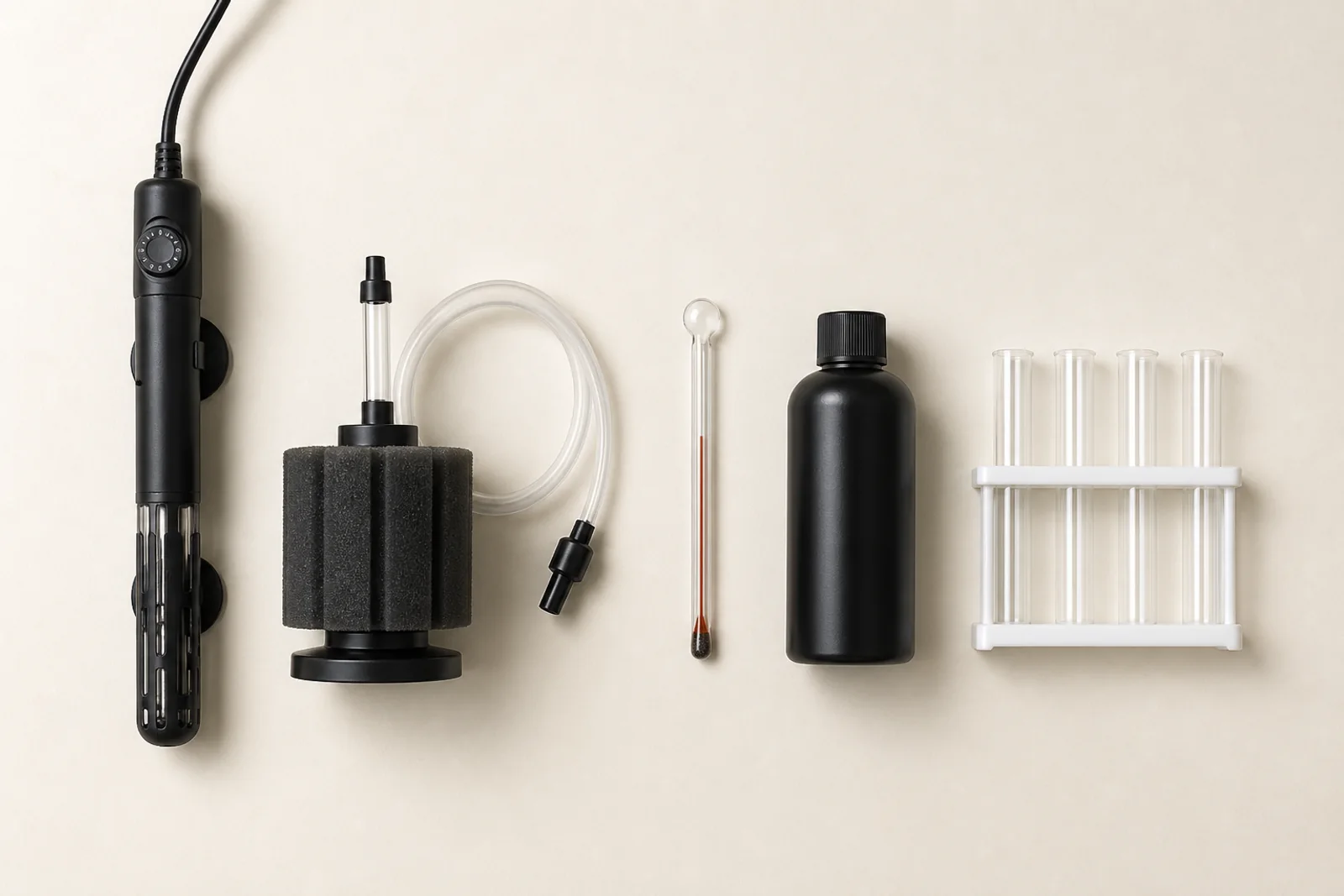
- Buy the tank, heater, filter, thermometer, dechlorinator and a liquid test kit. Liquid tests, not strips. Strips are too imprecise for the readings that matter.
- Set it up and run it empty. Substrate, plants, decor, lid.
- Cycle it. Add an ammonia source and wait until the tank converts a dose to zero ammonia and zero nitrite within 24 hours. This usually takes three to six weeks. It is the boring part and it is the part that works.
- Then buy the fish. Acclimate slowly, float the bag to match temperature, add tank water gradually, and net him in rather than pouring shop water into your tank.
- Leave him alone for a few days. Lights low, minimal food, no visitors.
If you already have the fish and no cycled tank, you can cycle around him with daily testing and frequent partial water changes. It is more work and harder on the fish, but it is recoverable.
Feeding
Bettas are carnivores. Flake food designed for community fish is a poor match.
- A quality betta pellet as the staple
- Two to four pellets, once or twice a day, sized to the fish
- Frozen or live bloodworms and brine shrimp as an occasional supplement
- Remove anything uneaten within a few minutes
A betta’s stomach is roughly the size of his eye. The amount that looks correct on the packaging is usually far too much, and uneaten food becomes ammonia.
Daily and weekly routine
| How often | What to do |
|---|---|
| Daily | Look at the fish, check the thermometer, feed the correct amount |
| Weekly | Test the water, change about 25%, wipe the glass, remove dying leaves |
| Monthly | Rinse filter media in removed tank water, never tap water. Check the heater against the thermometer |
That is roughly ten minutes a week once the tank is stable.
What a healthy betta looks like
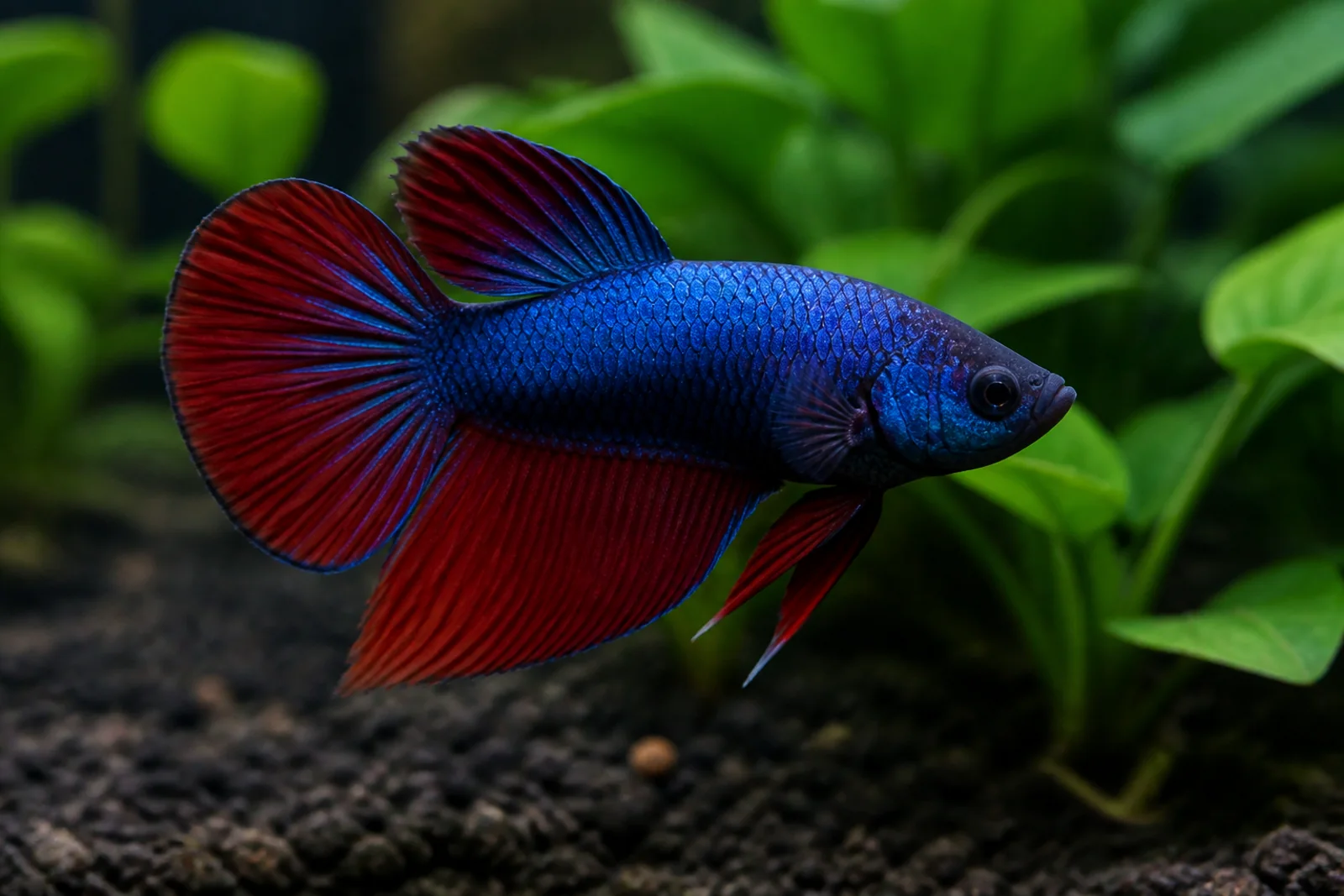
- Alert, aware of you, moving with purpose
- Fins carried open rather than clamped tight to the body
- Strong even colour, no white patches, fuzz or streaks
- Eating readily
- Building the occasional bubble nest, though its absence means nothing on its own
Early warning signs worth acting on: clamped fins, sitting on the bottom, refusing food, rubbing on decor, or ragged fin edges. Test your water first. Water quality is the cause far more often than disease.
Myths worth unlearning
“Bettas live in puddles.” They live in shallow, vast, connected water.
“They like small spaces.” They tolerate them. Tolerating is not preferring.
“They can breathe air, so they don’t need a filter.” Air solves oxygen, not ammonia.
“They don’t need a heater indoors.” Your house is not 26 °C at 4am.
“A plant vase kit is a complete home.” It is unheated, unfiltered and too small, and the roots do not feed the fish.
“Bettas are aggressive and can’t have any tank mates.” Males cannot share with males. Beyond that it depends on the individual and the tank.
If your betta is in a bowl right now
You are not the problem. You were told wrong, the same way most of us were.
Do these in order, and do not try to fix everything today:
- Heater and thermometer first. Chilling harms faster than a small tank does.
- Small frequent water changes, 25 to 50% every couple of days, dechlorinated and temperature matched.
- Cut the food back to two or three pellets a day.
- Upgrade when you can. A ten gallon with a sponge filter and adjustable heater ends the emergency for good.
Where to go next
Tank size is where most people are given the worst advice, and it deserves the full argument. Water parameters are what you will be testing every week for the life of the fish. Start with whichever is more urgent for you.