
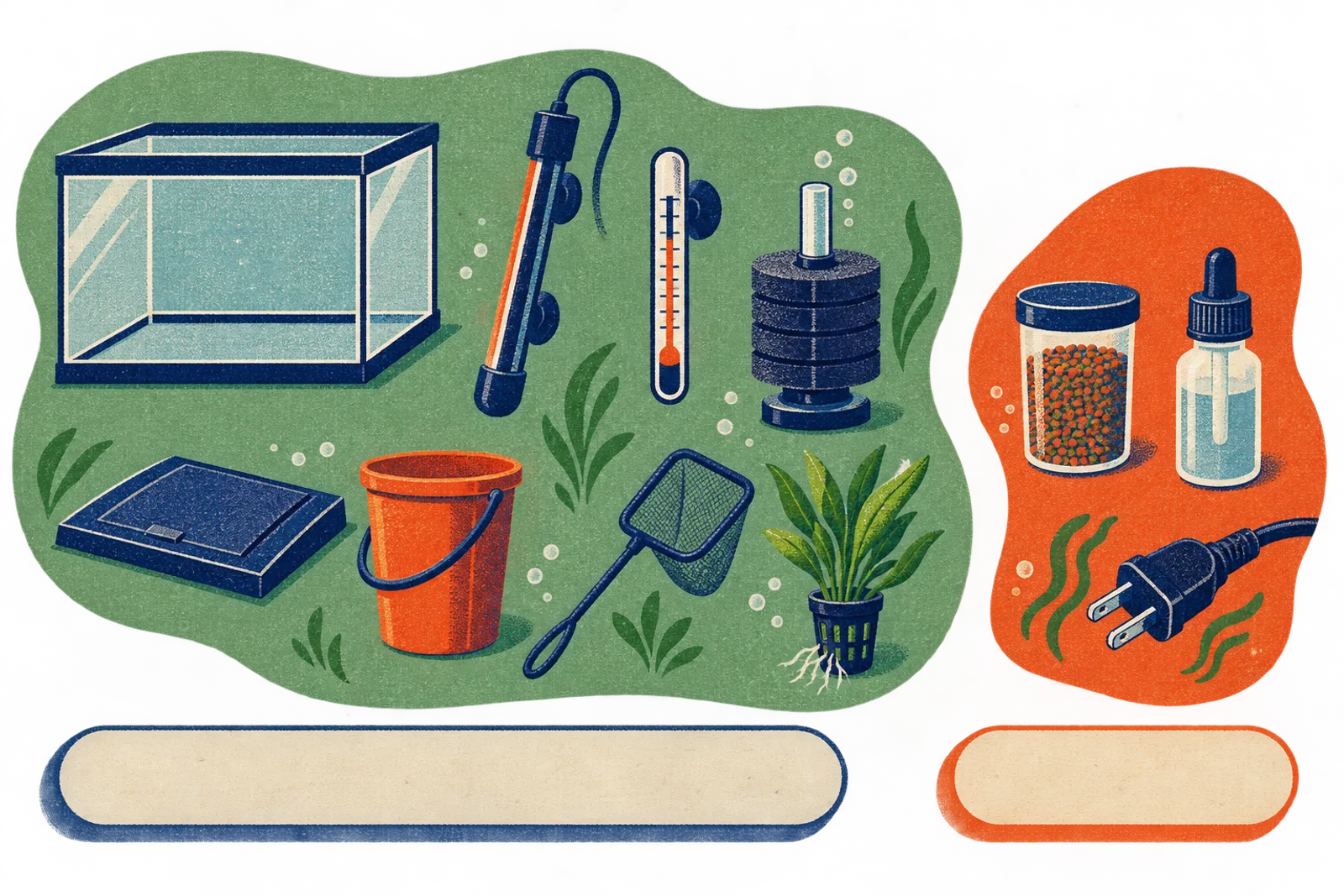
The fish costs a few dollars. Everything else is the actual expense, and it is mostly paid once.
This page gives you the complete list and the arithmetic. It does not give you a total, and the reason is in the next section.
Why there is no total on this page
We would have to make it up.
Prices differ by country, retailer, currency and year, and electricity tariffs differ by an order of magnitude between regions. A figure like “about ninety dollars a year” reads as researched and would be nothing of the sort. Inventing statistics is the one thing this site will not do, even where a number would be more satisfying than a method.
So below is the full shopping list, the recurring items, and a calculation you can run against your own bills. Fill it in once and you will have a real number instead of somebody else’s guess.
What you buy once
| Item | Notes |
|---|---|
| Tank, 5 gallons minimum | The largest single cost, and the one worth not economising on |
| Adjustable heater | Adjustable, not preset. Sized to the volume |
| Thermometer | Separate from the heater |
| Sponge filter, plus a small air pump | Cheap, quiet, and the bacteria live in it |
| Lid | Often included. Buy or cut one if not |
| Substrate | Sand or fine gravel |
| Live plants | Anubias and java fern last years |
| Liquid test kit | Runs several hundred tests |
| Siphon and bucket | Dedicated to the tank |
| Net | Dedicated to the tank |
| The fish | The smallest line on this list |
What you buy again
| Item | Roughly how often |
|---|---|
| Pellet food | A small tub lasts a single betta many months |
| Water conditioner | Depends on water change volume. A bottle lasts a long time |
| Test kit refills | When a reagent bottle empties |
| Filter sponge | Rarely. Rinse it in tank water, replace only when falling apart |
| Frozen treats | Optional |
| Electricity | Continuous, see below |
| Replacement heater | Heaters fail eventually. Budget for one every few years |
That last row is the one people forget. A heater is a consumable on a multi-year cycle, and the failure mode that matters is a heater stuck on.
Calculating your electricity cost exactly
This is the one number you can work out precisely rather than estimate.
kWh per day  = (heater watts × hours running per day) ÷ 1000
cost per day = kWh per day × your tariff per kWh
cost per year = cost per day × 365
Two notes that keep the answer honest.
A heater does not run continuously. It cycles on to hold temperature and off again, and the proportion depends on how cold the room is. Using the full 24 hours gives you a worst case, not a typical case. If you want a realistic figure, a plug-in energy meter measures the actual draw over a week.
Add the air pump for the sponge filter and the light. Both are small, and both are easy to leave out and then wonder why the total looks low.
Your tariff per kWh is on your electricity bill. Use that, not a national average.
Where the money actually gets wasted
Four purchases made twice, in order of how often it happens.
A tank under five gallons. It gets replaced, either because the fish struggles or because the owner learns better. Buying ten gallons first is cheaper than buying three then ten.
A preset heater. Cannot be adjusted, frequently sits at the wrong temperature, and gets replaced by an adjustable one.
Test strips. Bought for convenience, found unreadable at low ammonia, replaced by a liquid kit. Buy the liquid kit.
Plastic ornaments. Bought for looks, tear the fins, replaced with silk or live plants. Buy plants.
The cheap version that is not cheap
A cup fish, a bowl and a tub of generic flakes is the lowest price at the till and the highest cost over time, because the fish does not last. A cycled, heated five gallon is a modest one-off outlay that produces a fish living out its actual lifespan.
That is the entire economic argument, and it happens to be the welfare argument as well.
Where to go next
The tank size guide covers why five gallons is the floor. The tested tanks guide covers what to look for in a specific purchase, and the bowl article covers why the cheapest option on the shelf is the expensive one.