
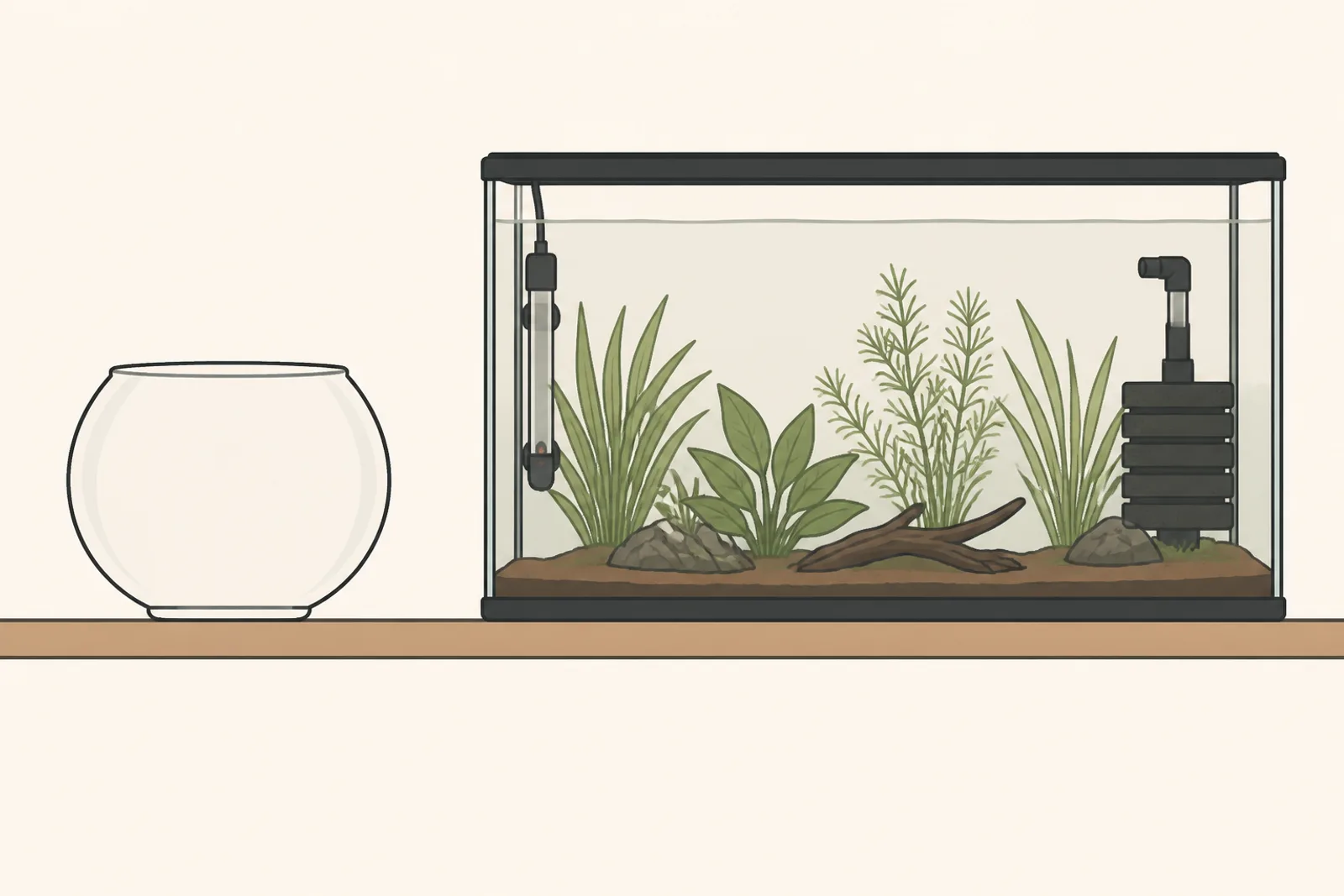
Yes, a betta can live in a bowl. That is the honest start, and it is the whole reason bowls are still on sale.
A betta in a bowl does not die on the first day. It often lasts months. The question worth asking is not whether the fish survives but what the bowl costs it, and the answer is most of its lifespan.
What a bowl actually does
Three failures, and they make each other worse.
| Problem | Consequence |
|---|---|
| Cannot be heated reliably | The fish tracks room temperature and rides every overnight drop |
| Cannot be filtered | No bacterial colony, so ammonia accumulates continuously |
| Too little volume | Waste concentrates fast and temperature swings quickly |
A cold fish has a suppressed immune system. A fish in ammonia has burned gills. A fish in a small volume gets both faster. That is the mechanism, and it is why bowl-kept bettas so often die of something that looks like bad luck.
The two arguments for bowls
“They breathe air, so they do not need a filter.” They do have a labyrinth organ and they do take oxygen from the surface. Breathing air solves oxygen. It does nothing about ammonia, nitrite or temperature. A fish that can breathe in bad water is still living in bad water.
“They live in puddles.” They live in rice paddies, floodplains and canals: shallow, warm, and vast. Shallow is not small. A paddy is a very large volume of water that happens to be a few inches deep, and it is constantly refreshed.
If your betta is in a bowl right now
You are not the problem. Bettas are sold in cups with bowls recommended alongside them, and almost everyone starts here.
Nothing below requires fixing everything today.
- Get a heater and a thermometer. Chilling harms faster than the small volume does, and this is the cheapest single improvement.
- Change 25 to 50 percent of the water every two or three days, dechlorinated and temperature matched.
- Cut the food back to two or three pellets a day. Less food means less ammonia.
- Upgrade when you can. A five or ten gallon with a sponge filter and an adjustable heater ends the problem permanently.
Step four is the one that matters. Steps one to three are how you buy time.
What to buy instead
A rectangular tank of at least five gallons, and ten if the space and budget allow. A fitted lid, because bettas jump. An adjustable heater and a separate thermometer. A sponge filter. That is the list.
It is not expensive, and it costs less than replacing a fish twice.
Where to go next
The full tank size argument covers why five gallons is the floor and what volume actually changes.