
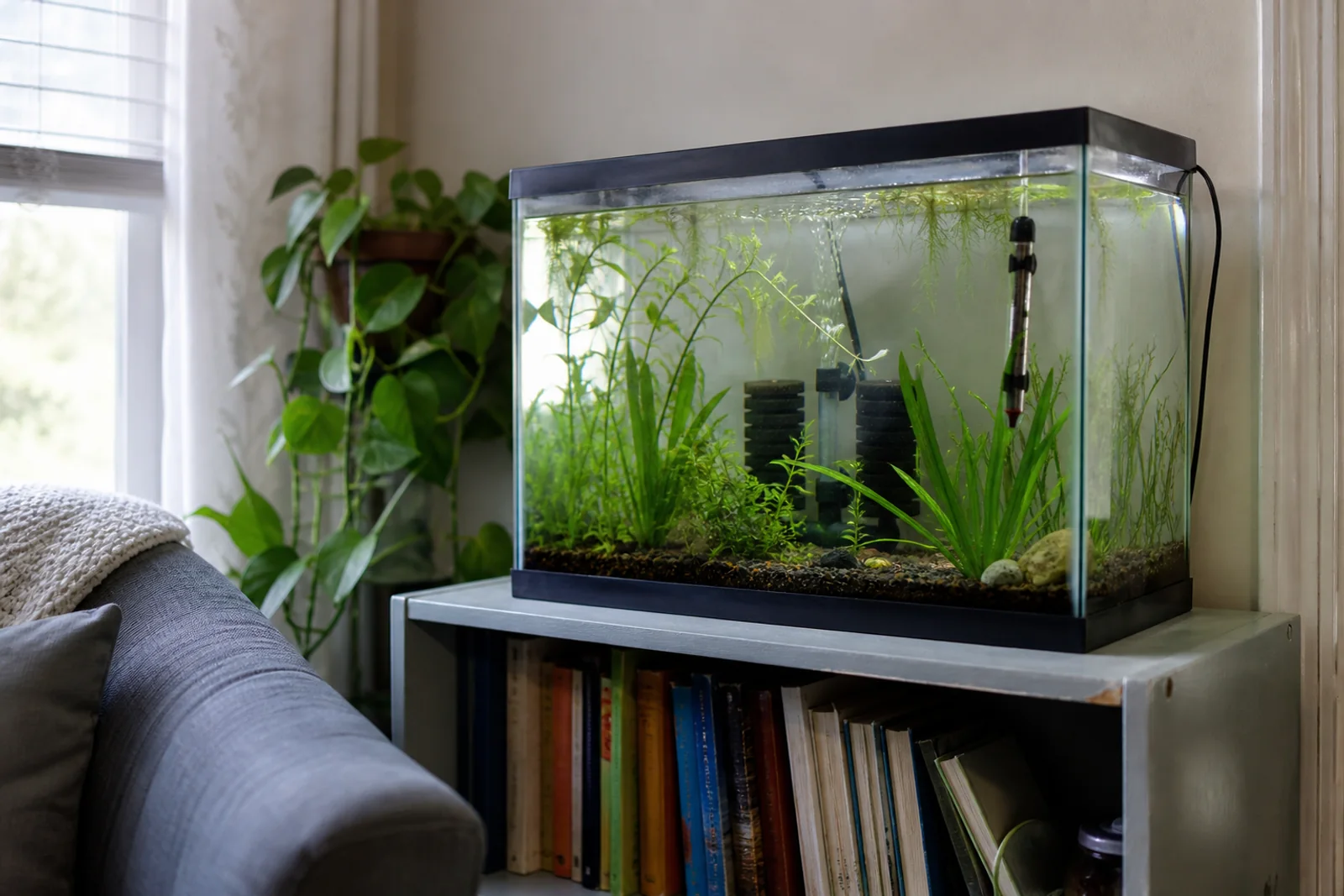
Easy to keep alive. Harder to keep well. That gap is where most of the disappointment in this hobby lives, and it is almost entirely about equipment rather than about the fish.
What makes a betta easy
It tolerates a wide pH range, so you do not manage water chemistry.
It lives alone, so there is no compatibility problem to solve.
It eats a simple dry food, readily, and needs very little of it.
It is visibly interactive. It learns who you are, comes to the front, and shows what it is feeling in ways you can read once you know the baseline.
It is small, so the tank fits on a shelf.
What makes it hard
The work is front-loaded and invisible.
A tank has to be cycled before the fish arrives, which takes three to six weeks of adding an ammonia source and testing while nothing appears to happen. Nobody at the till mentions this, and it is the single thing that decides whether the fish lives.
It needs a heater, because it is tropical and a room is not.
And it needs you to notice things. A betta that goes off food or clamps its fins is telling you something several days before anything is visible, and only if you are looking.
The actual time cost
| When | What | How long |
|---|---|---|
| Before the fish | Set up and cycle the tank | Weeks of waiting, minutes of work |
| Daily | Look at the fish, read the thermometer, feed | About a minute |
| Weekly | Test, change a quarter of the water, wipe the glass | About ten minutes |
| Monthly | Rinse filter media in removed tank water | Five minutes |
That is genuinely modest. It is not zero, and the shop cup implies zero.
Why so many die
Not because the species is delicate. Bettas are among the hardier freshwater fish and survive conditions that would kill most tropicals.
They die because the standard retail package is a bowl or a small kit with no heater and no filter. The fish is then cold, which suppresses its immune system, and sitting in ammonia, which burns its gills. Those two compound, and the death gets recorded as bad luck.
Give the same fish a cycled, heated five or ten gallon and it is easy.
Who should wait
If you cannot fit a five gallon tank, wait until you can.
If you want the fish this weekend, wait, because the tank needs weeks first. This is the hardest advice to follow and the most valuable.
If you want something that needs no weekly attention, a betta is not it. Nothing alive is.
Who will get on with it
Anyone willing to buy the equipment before the animal, and to spend ten minutes a week on it afterwards. That is the whole test.
Where to go next
The care guide covers everything from setup to routine. The cost article covers what the equipment actually comes to, and the bowl article covers why the cheapest option at the till is the expensive one.