
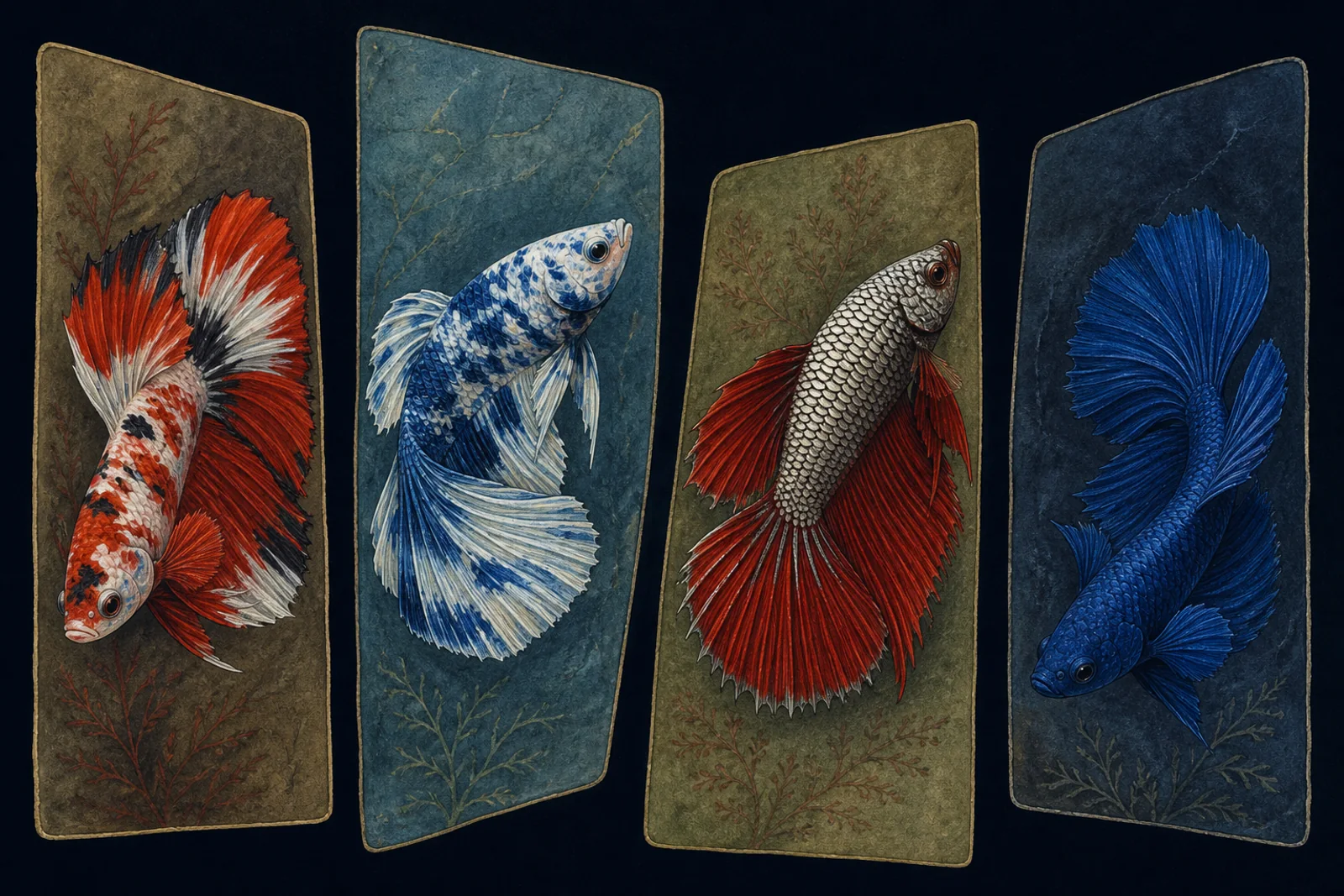
Betta colour names are trade terms. They describe what a fish looks like, they are applied loosely by shops, and the same fish can honestly be sold under two of them.
Knowing which is which is useful for reading a listing. It tells you nothing about how the fish will behave.
The patterns you will actually see
| Name | What it describes |
|---|---|
| Solid | One colour across body and fins |
| Bi-colour | Body one colour, fins another |
| Butterfly | Solid body, fins banded pale or clear at the outer edge |
| Marble | Irregular patches that migrate over the fish’s life |
| Koi | Marble pattern in red, black, white and orange, usually on a plakat |
| Galaxy or koi galaxy | Marble base with scattered iridescent speckling |
| Dragon scale | Thick opaque metallic scaling, like plating |
| Cambodian | Pale body with strongly coloured fins |
| Mustard gas | Dark body with yellow or orange fins |
| Copper or metallic | Iridescent sheen that shifts with the light |
None of these are breeds. There is no registry behind them, and a shop labelling a fish koi galaxy dragon is describing three features at once rather than naming a lineage.
Marble, and why your fish looks different
The marble gene makes pigment cells migrate. A fish that arrives mostly white can develop black patches over a month, lose them, and gain red ones. Koi bettas carry it, which is why a koi betta rarely looks the same at a year old as it did in the cup.
This is normal, genetic, and not a symptom. It is one of the more interesting things about keeping the pattern type.
Two other harmless colour changes: young fish deepen and saturate as they mature, and most bettas pale slightly at night or when resting.
When colour change is a signal
The change itself is not the signal. What accompanies it is.
Worth acting on when colour loss comes with fins held clamped against the body, lethargy on the substrate, refusing food, or faster than usual breathing. That combination points at water quality first, and stress or infection second.
Also worth a closer look: white patches with texture rather than a change in hue, which is a growth rather than a pigment shift, and reddening around the gill covers, which suggests ammonia.
So the rule is simple. A fish whose pattern is shifting while it eats, patrols the tank and holds its fins open is a marble. A fish losing colour while doing none of those things needs a water test.
Dragon scale, and the eye problem
Dragon scale bettas are popular for good reason and they carry a specific known issue. The scaling is thick and opaque, and in some lines it continues growing across the eyes, clouding them and impairing vision. Keepers call it diamond eye.
An affected fish can live a full life and will struggle to find food and to navigate. If you are drawn to dragon scales, look closely at the eyes in the shop and choose a fish whose eyes are clear and unobstructed by scaling.
This is the one place where a cosmetic label has a welfare consequence attached.
What colour does not tell you
It does not predict temperament. Aggression varies between individuals and not between colour types, despite the reputation red fish have.
It does not predict hardiness. A fish’s health comes from how it was bred and raised and from your tank, and no pattern is inherently tougher.
It does not indicate sex. Females come in the same patterns, usually more muted, and fin length is the reliable signal.
Choose the fish, then the colour
In practice: walk the shelf, discard every cup holding a fish with clamped fins, white patches, ragged fin edges, a cloudy eye or no response when you approach. Then pick your favourite colour from what is left.
Doing it the other way around is how people end up nursing a sick fish they chose for its markings.
Where to go next
The types pillar covers tail shapes and finnage, which affect how well the fish swims, and the selection guide covers reading a shop cup in detail.