
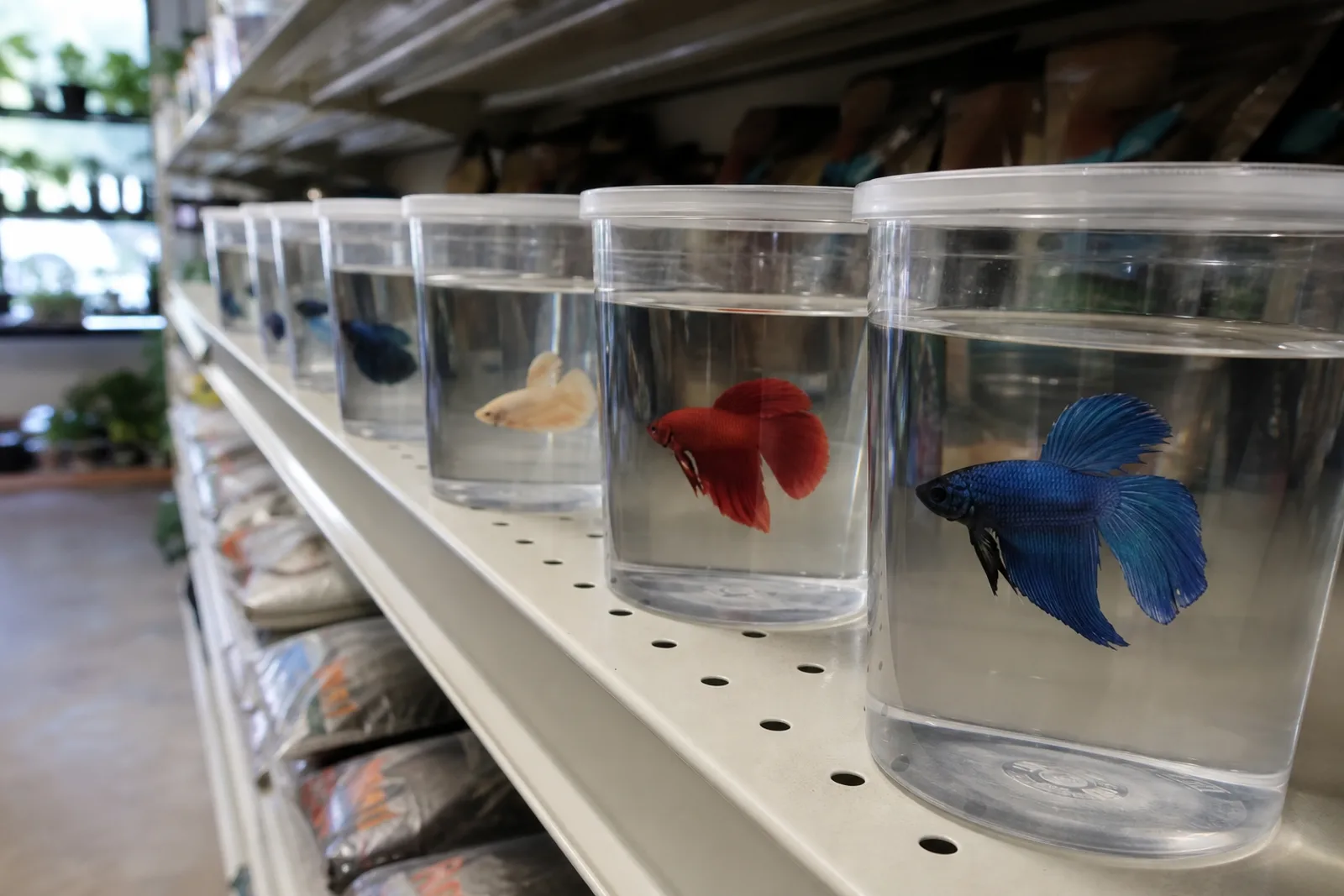
The most useful advice about buying a betta is about timing rather than the fish.
What to look for
Four signals, in order of how much they tell you.
| Signal | What good looks like |
|---|---|
| Fins | Carried loose and spread, not pinned to the body |
| Colour | Even and strong, no white or grey patches, no fuzz, no dusty sheen |
| Eyes | Both clear, same size, neither cloudy nor protruding |
| Reaction | Notices your hand near the cup, often flares or swims over |
Clamped fins is the most reliable of the four, because it shows before colour or appetite change. Complete indifference to your hand is the one people most often talk themselves out of, and it is worth taking seriously.
Warning signs
| What you see | What it may mean |
|---|---|
| Fins clamped tight to the body | Stress, poor water, or early illness |
| White fuzzy patches | Fungal infection |
| Fine gold or rust dust on the body | Velvet |
| White spots like grains of salt | Ich |
| Swollen belly with raised scales | Dropsy, and the prognosis is poor |
| Bulging eye | Popeye |
| Lying on its side or struggling to stay level | Swim bladder problem |
| Ragged or receding fin edges | Fin rot, or cup damage |
| Motionless and unresponsive | Could be cold, could be much worse |
The last one deserves a note. Shop cups are often at room temperature, and a cold betta looks like a dying betta. It may simply be chilled. That does not make it a safe purchase, because you cannot tell from the shelf.

Judge the shelf, not the sign
Big-box shops and specialist stores buy from the same farms. Florida produces roughly 95 percent of the freshwater ornamental fish farmed in the United States, and that stock is distributed widely.
What differs is what happens after delivery. Look at the shelf as a whole:
Is the water in the cups clear or is it yellowing? Are the cups at room temperature or is the shelf heated? How many fish on the shelf look listless? Is there a dead fish still sitting in a cup?
One poor-looking fish among twenty is normal. A shelf where half the stock is clamped and the water is cloudy tells you these fish have been there a while in conditions nobody is monitoring.
The rescue question
You will see a fish that looks awful and feel you should take it home. That impulse is decent, and it is worth being honest about what it involves.
A sick betta needs a separate quarantine tank, a diagnosis you may not be able to make, medication you may not be able to source, and an outcome that is often death anyway. It is a project.
For a first fish, buy the healthy one and get good at keeping it alive. Rescues are for when you have a spare cycled tank and the stomach for losing some.
After you buy
Get it home reasonably quickly and keep the bag or cup out of direct sun and away from a cold car footwell.
Then acclimate slowly. Float the sealed bag for fifteen to twenty minutes to match temperature, add a little tank water every five minutes for about half an hour, and net the fish in rather than pouring shop water into your tank.
Then leave it alone. Lights low, no food the first day, no visitors. A few days of hiding after a move is normal and not a sign you chose badly.
Where to go next
The complete care guide covers the setup you should already have running before the fish comes home.