
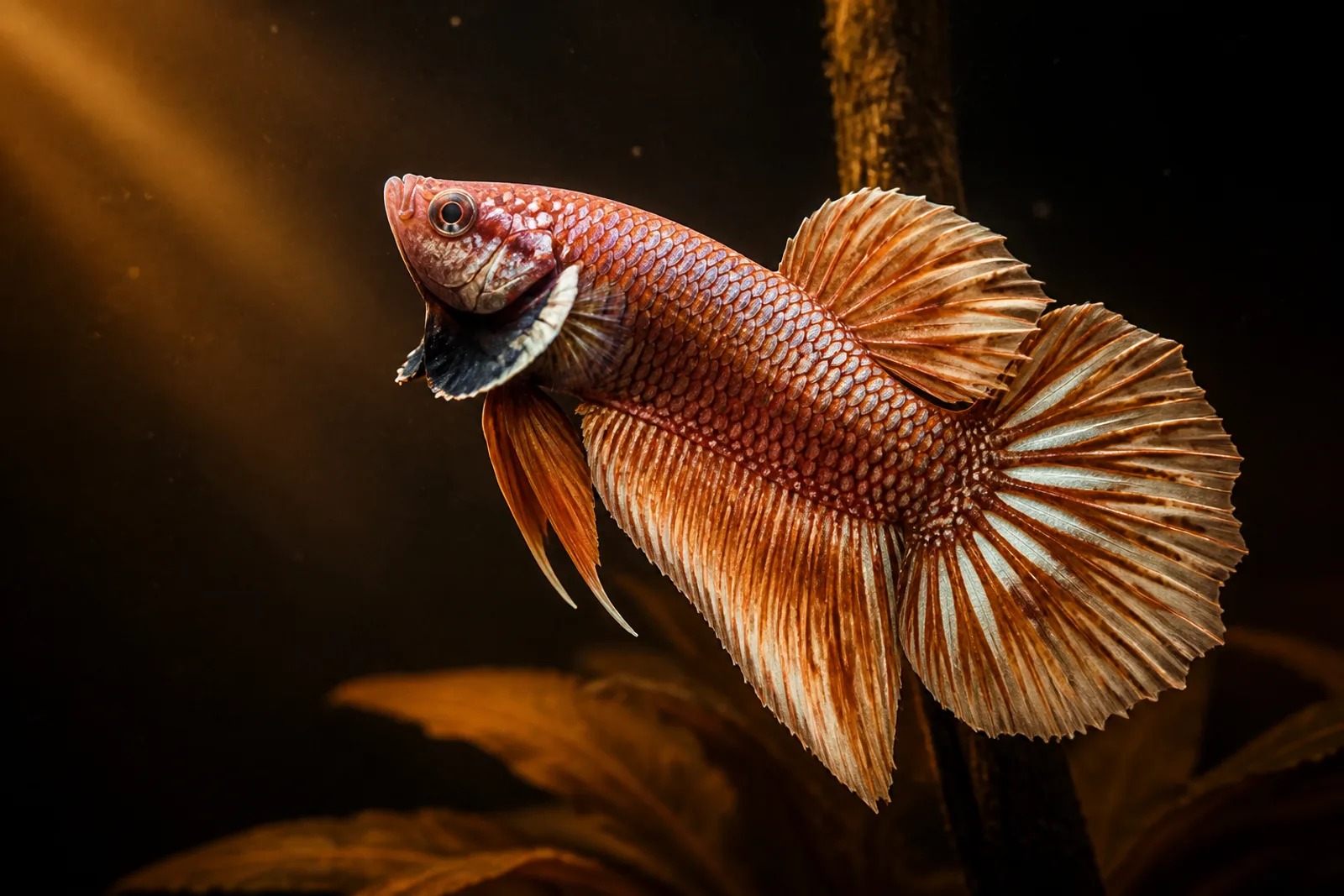
A flaring betta spreads its gill covers outward, extends the membrane beneath its head, and opens every fin. It is the most photographed thing the species does and it is a threat.
Not a greeting, not a stretch, and not a sign the fish is pleased.
What is happening physically
The gill covers hinge open sideways, making the head look several times wider. The operculum membrane, usually called the beard, drops below the jaw. The fins go fully open, and the fish often turns broadside to look as large as possible.
Males do all of this dramatically. Females do a reduced version with a small or invisible beard.
The whole display exists to make a rival leave without a fight. That is its function in the wild, where a defeated fish swims away into a large body of water.
The triggers
| Trigger | Common in a solo tank |
|---|---|
| Own reflection on the glass | Very common |
| Another betta, or a fish with long fins | Only if housed together |
| A hand or face above the tank | Common early on |
| A new object or rearranged decor | Briefly, then it passes |
| A snail or shrimp moving | Occasionally |
The reflection is the one that matters, because it does not go away. A bright tank in a dim room turns the glass into a mirror, and the fish spends the evening displaying at an opponent that mirrors every move and never yields.
Why mirror training is a bad idea
The claim is that flaring exercises the fish and keeps its fins strong. There is no established welfare benefit behind it, and the mechanism works against the fish: flaring is a stress display, and a mirror creates an opponent that cannot be driven off.
If the goal is an active fish, the answer is a larger tank with plants, wood and sight lines to move through. A betta in a well-planted ten gallon patrols it all day without any prompting.
When flaring is a problem
Occasional short bursts are fine and normal.
Worth acting on when the fish flares for long stretches, when it is flaring at the glass every evening, or when it stops eating and hangs at one wall of the tank. Prolonged display costs energy and keeps the fish in a heightened state.
The fix is to remove the trigger:
- Raise the room light or lower the tank light so the glass stops reflecting
- Put plants directly against the glass where the flaring happens
- Add a background to the back and at least one side panel
- If another fish is the trigger, they should not be sharing a tank
Reading the fish instead
The behaviour worth watching for is the opposite of flaring. Fins clamped tight against the body, sitting on the substrate, refusing food: that is the sign something is wrong, and it usually means the water, not the neighbours.
Where to go next
The types pillar covers fin varieties and how they affect a fish’s ability to move, and the tank mates guide covers which companions trigger this and which do not.