
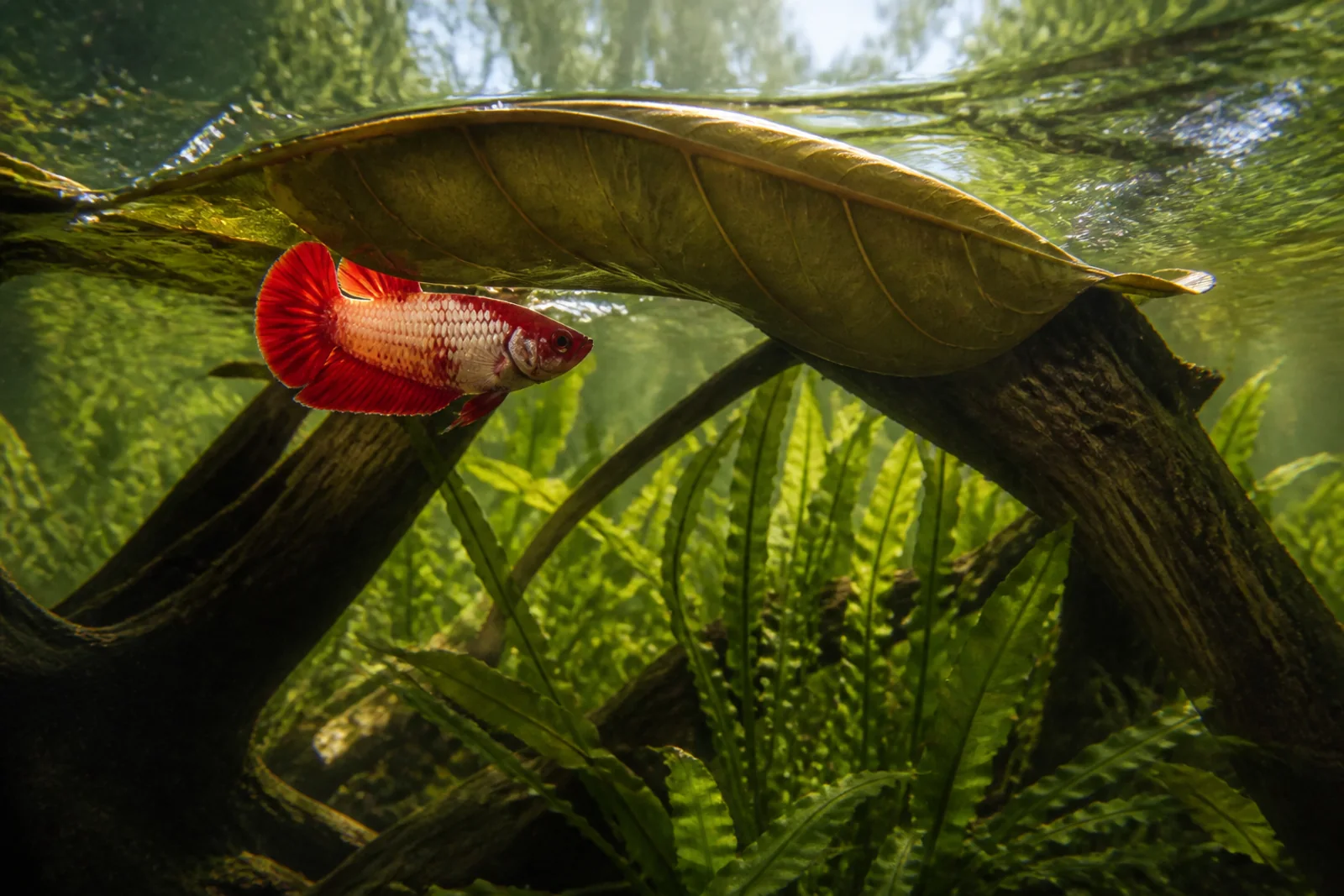
Bettas investigate things. Put a new piece of wood in a tank and the fish will inspect it within the hour, look behind it, and swim through any gap it makes.
Whether the absence of that counts as boredom is a question about what fish experience, and nobody can answer it confidently. What is observable is that a betta in a furnished tank behaves differently from one in a bare box, and the difference is worth having.
What actually works
A larger tank. Ten gallons instead of five is more exploring than any object you could add. This is the single biggest change available.
Live plants. Broad leaves to rest on, stems to weave through, floating cover to sit under. They create places rather than obstacles.
Driftwood and caves. Something to go behind, under and around. A betta with a route it can patrol will patrol it.
Broken sight lines. A tank where the fish cannot see everything from one spot gives it a reason to move.
Varied food, in varied places. Dropping a frozen treat at a different corner engages a foraging instinct that a pellet at the same spot twice a day does not.
Gentle rearrangement, occasionally. Moving a piece of wood every couple of months makes the territory new again. Occasionally, not weekly, because constant change is a stressor rather than a stimulus.
What does not
Mirrors. These are sold as exercise and they are the clearest failure on the list. Flaring is a threat display, and a mirror produces an opponent that never leaves and never yields. Brief occasional flaring is normal; a fish held in it is in a sustained stress state for no benefit.
A bright bare tank with a colourful ornament. The ornament is for you. The brightness works against a species that comes from shaded, vegetated water.
More fish. Adding company to entertain a betta misreads the animal. It lives alone by preference, and a tank mate is a management problem rather than a friend.
Feeding more often. Attention and food are different things, and a betta will accept food indefinitely regardless of whether it needs it.
Training, if you want a project
Many bettas learn to follow a finger along the glass, to swim through a hoop, or to come to a specific corner when you appear.
Short sessions, a food reward, and stopping when the fish disengages rather than pushing on. It is genuinely interactive and it is a supplement to a good tank, not a replacement for one.
The important caveat
A fish that used to explore and now sits still is far more likely to be unwell than bored.
Test the water and read the thermometer before you start rearranging furniture. Reduced activity is one of the earliest signals of cold water or ammonia, and both are correctable the same evening.
The honest summary
The best enrichment for a betta is a bigger tank with plants in it. Everything on the rest of this page is a refinement, and none of it substitutes for the space.
Where to go next
The types pillar covers behaviour and what the different varieties can physically do. The flaring article covers why mirrors fail, the plants guide covers the species that furnish a tank, and the healthy signs article covers telling a resting fish from a declining one.