
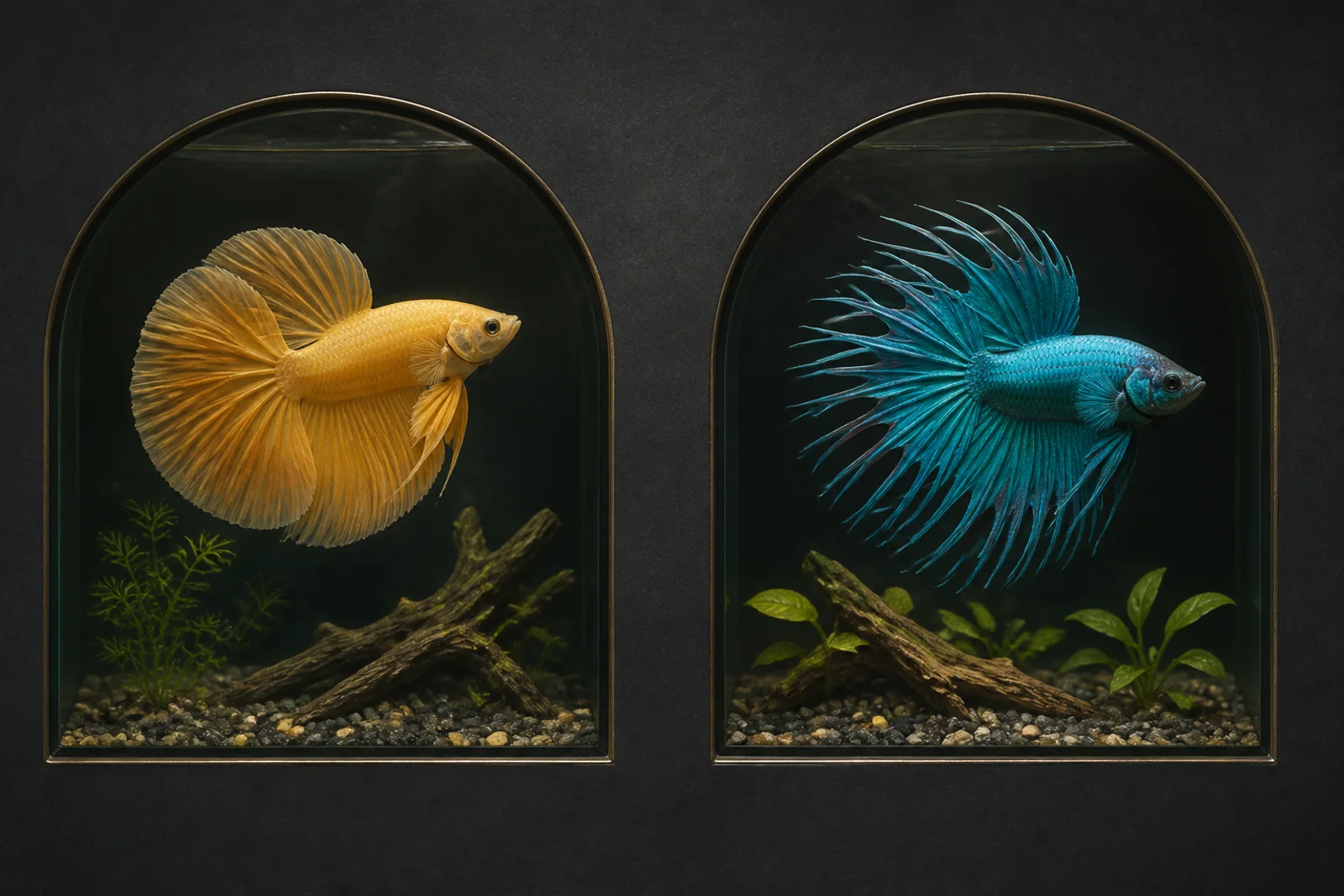
Halfmoon and crowntail are the two tail shapes most people are choosing between, and the honest answer is that the decision is aesthetic. The care sheet does not change.
What does change is how the fish moves and what the tank has to avoid.
The two shapes
A halfmoon caudal fin spreads into a smooth half circle, ideally a full 180 degrees, with the webbing continuous to the edge.
A crowntail has fin rays that extend past that webbing, so the trailing edge is spiked rather than smooth. The proportion of ray to webbing varies, and heavy examples look like a comb.
Both are selectively bred exaggerations. A wild betta has a short, functional tail and neither of these.
Side by side
| Halfmoon | Crowntail | |
|---|---|---|
| Edge | Smooth, continuous | Spiked rays past the webbing |
| Fin mass | High | High, distributed differently |
| Swimming | Laboured, tires quickly | Laboured, tires quickly |
| Typical damage | Webbing tears | Rays snap |
| How damage looks | A split or notch | Alarming, often heals fine |
| Care requirements | Identical | Identical |
What heavy fins cost the fish
A betta carrying this much fin is dragging weight. It swims in bursts, rests often, and struggles in current that a plakat would ignore.
Three consequences for the tank, and they apply to both types.
Flow has to be gentle. A fish pinned against the glass by the filter outflow is being worn down. Baffle it or use a sponge filter.
Nothing sharp. Stiff plastic plants and ornaments with unfinished seams tear fins, and a tear in water carrying any bacterial load is an entry point for infection. Silk or live plants instead.
Resting places near the surface. Broad leaves in the upper third let the fish sit close to where it breathes without swimming for it.
Damage, and telling it from disease
Both types get physically damaged, and both usually heal in clean warm water.
The distinction that matters is between a clean split or a snapped ray, which is mechanical, and tissue receding from the edge with a darkened or white margin, which is fin rot. Mechanical damage stops where it happened. Rot keeps moving.
A crowntail with broken rays often looks far worse than a halfmoon with the same degree of injury, simply because the spikes make it obvious.
Choosing in the shop
Ignore the tail for a moment and pick a healthy fish first. Alert, responsive when you approach the cup, fins carried open rather than clamped, no white patches, no ragged edges, clear eyes.
Then choose the shape you like from the ones that pass. Doing it the other way around is how people end up nursing a sick fish they chose for its fins.
Where to go next
The types pillar covers the full range of tails and colours. The plakat article covers the short-finned alternative, and the decor guide covers making a tank that does not tear fins in the first place.