
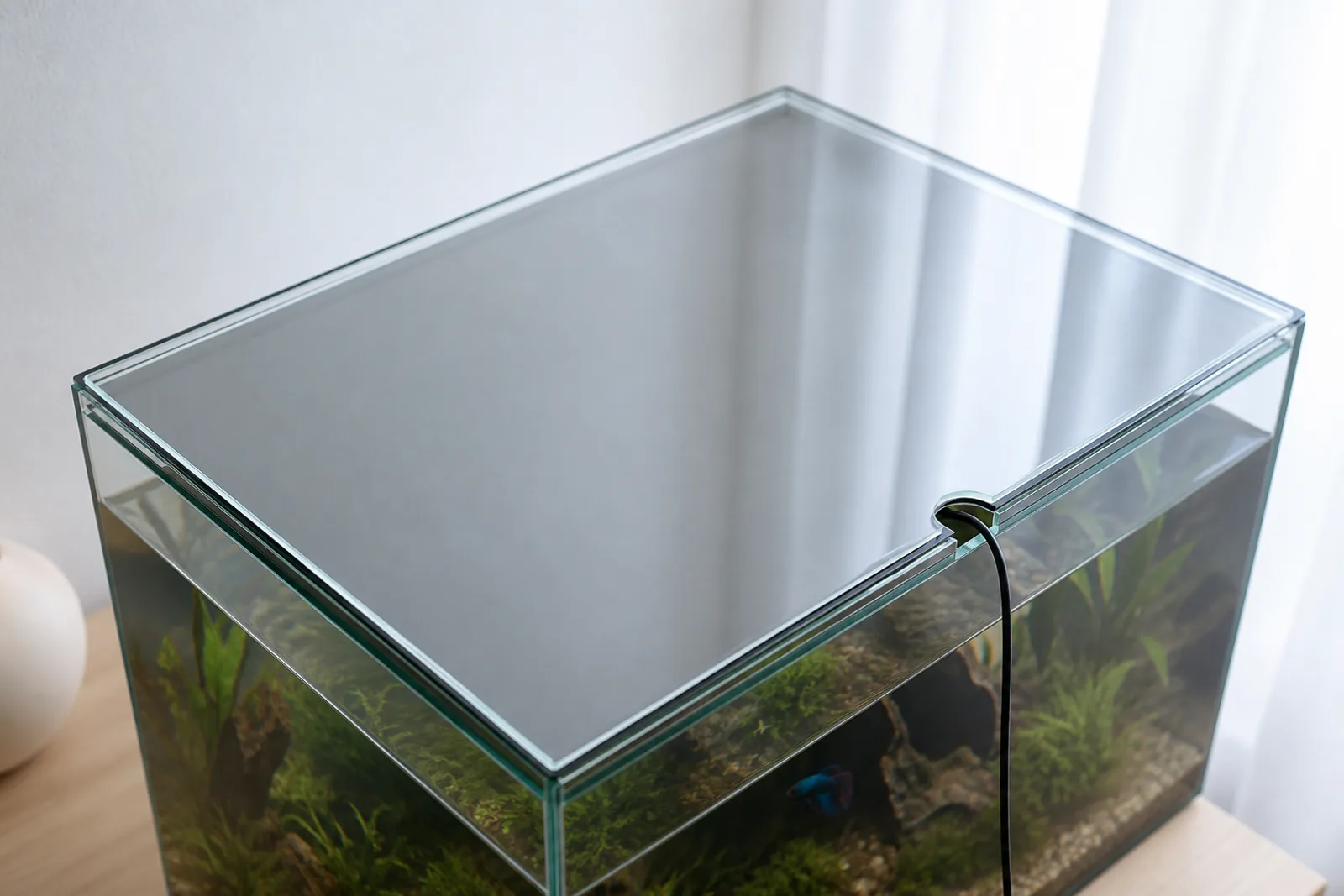
Two things kill bettas in otherwise well-run tanks. They jump out, and they get torn up by their own decorations.
Both are entirely preventable and both are cheap to prevent.
Bettas jump
In the wild they live in shallow water that shrinks and moves, and jumping between pools is a normal part of that. The instinct did not disappear because your fish was bred in a farm tank.
They jump when startled by movement outside the glass, when going after something at the surface, when the water is too warm, and sometimes with no visible trigger at all. A fish on the floor overnight is not found in time.
Getting the lid right
| Requirement | Detail |
|---|---|
| Cover the whole surface | An inch or two of gap is a route out |
| Manage cable gaps | Cut a slot only as wide as the cable, or use mesh |
| Two to three inches of air | The fish must reach the surface to breathe |
| Do not fill to the brim | High water plus a startled fish equals a fish on the floor |
| Check after maintenance | The lid left half-open after a water change is the classic loss |
That last row is worth repeating because it is the most common version of this accident. The lid was on for six months, it came off for a Sunday water change, and it did not go back properly.
If your tank came without a lid, a piece of cut acrylic or glass with a notch for cables does the job. Mesh works too and lets more air through, which suits a heavily planted tank.
The air gap matters
Do not press the lid down onto the water.
A betta breathes atmospheric air at the surface through its labyrinth organ, and the pocket of warm humid air between the water and the lid is part of why the gap exists. Cold dry room air hitting the labyrinth organ repeatedly is a stressor. Two to three inches of trapped warm air solves it.
Decor that shreds fins
A betta’s fins are large, thin and slow to manoeuvre. The fish cannot dart away from an obstacle the way a tetra can, so it brushes things constantly.
Stiff plastic plants are the main offender. The moulded edges are hard and often have a seam ridge from the mould. They tear fins. Silk plants flex and do not, and live plants are better than either.
Narrow openings trap fish. Resin ornaments with small cave mouths, hollow logs with one tight end, anything a fish can enter head first and cannot reverse out of. A betta that has wedged itself will exhaust and die there.
Sharp seams and chipped paint. Cheap ornaments have unfinished seams from the moulding process and painted surfaces that flake.
The stocking test
Take a pair of tights or a stocking. Drag it across every surface of a new ornament, and pull it through every hole and opening.
If the fabric snags anywhere, a fin will snag there too. If it passes cleanly, the ornament is fine. This takes a minute, costs nothing, and catches nearly everything worth catching.
Do it before the ornament goes in the tank, not after you have noticed a split fin.
Why torn fins matter beyond looks
A tear is an open wound. In water carrying any bacterial load, and every aquarium carries one, a wound is an entry point.
Most small tears heal cleanly in good water. Repeated tears in water that is not quite clean is how fin rot starts, and at that point you are treating an infection that a silk plant would have prevented.
Where to go next
The setup guide covers where decor and lids fit in the build order. The live plants guide covers species that give better cover than any ornament does, and the fin rot guide covers what happens when a tear does get infected.