
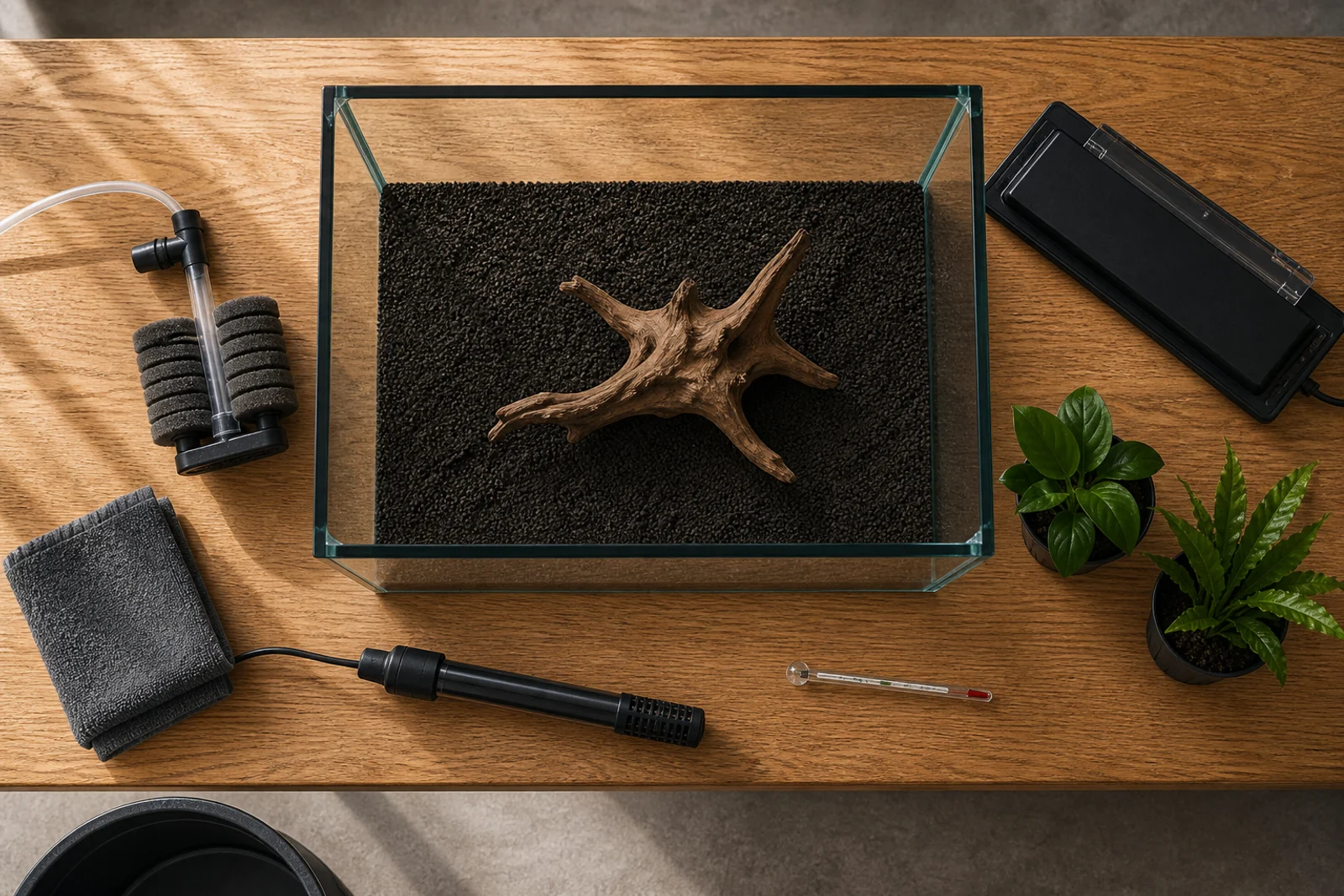
The order matters more than the shopping list. Almost everyone buys the fish first and the equipment afterwards, and that single sequence causes most beginner losses.
Here is the order that works: buy the equipment, build the tank, cycle it empty for a few weeks, then buy the fish.
What to buy
| Item | Why | Notes |
|---|---|---|
| Tank, 5 gallons minimum | Dilutes waste, holds temperature | 10 gallons is easier, not harder |
| Adjustable heater | Bettas are tropical | Sized to the tank, not the smallest one sold |
| Thermometer | Heater dials are often wrong | Separate from the heater |
| Gentle filter | Houses the bacteria | Sponge filter, or a baffled hang-on-back |
| Lid | Bettas jump | Not optional |
| Dechlorinator | Tap water contains chlorine | Any standard conditioner |
| Liquid test kit | The only way to see the cycle | Not strips |
| Substrate | Surface for bacteria | Sand or fine gravel |
| Plants and a cave | Cover reduces stress | Live, or silk if artificial |
That is the entire list. The total is not large, and it is far less than replacing a fish twice.
Step 1: position the tank
Pick the spot before it has water in it, because a full tank cannot be moved.
- Out of direct sunlight, which drives algae and temperature swings
- Away from radiators, air conditioning and draughty doors
- On furniture that can take the weight. Roughly 8.3 lb per gallon, plus substrate
- Near a socket, and leave room to get your arms in
Step 2: rinse and add substrate
Rinse sand or gravel in a bucket until the water runs almost clear. This takes longer than you think and skipping it means a cloudy tank for a week.
Two inches is plenty. Slope it slightly higher at the back if you want depth in the view.
Step 3: hardscape and plants
Put in wood, rock and caves before you fill, so you can move things freely.
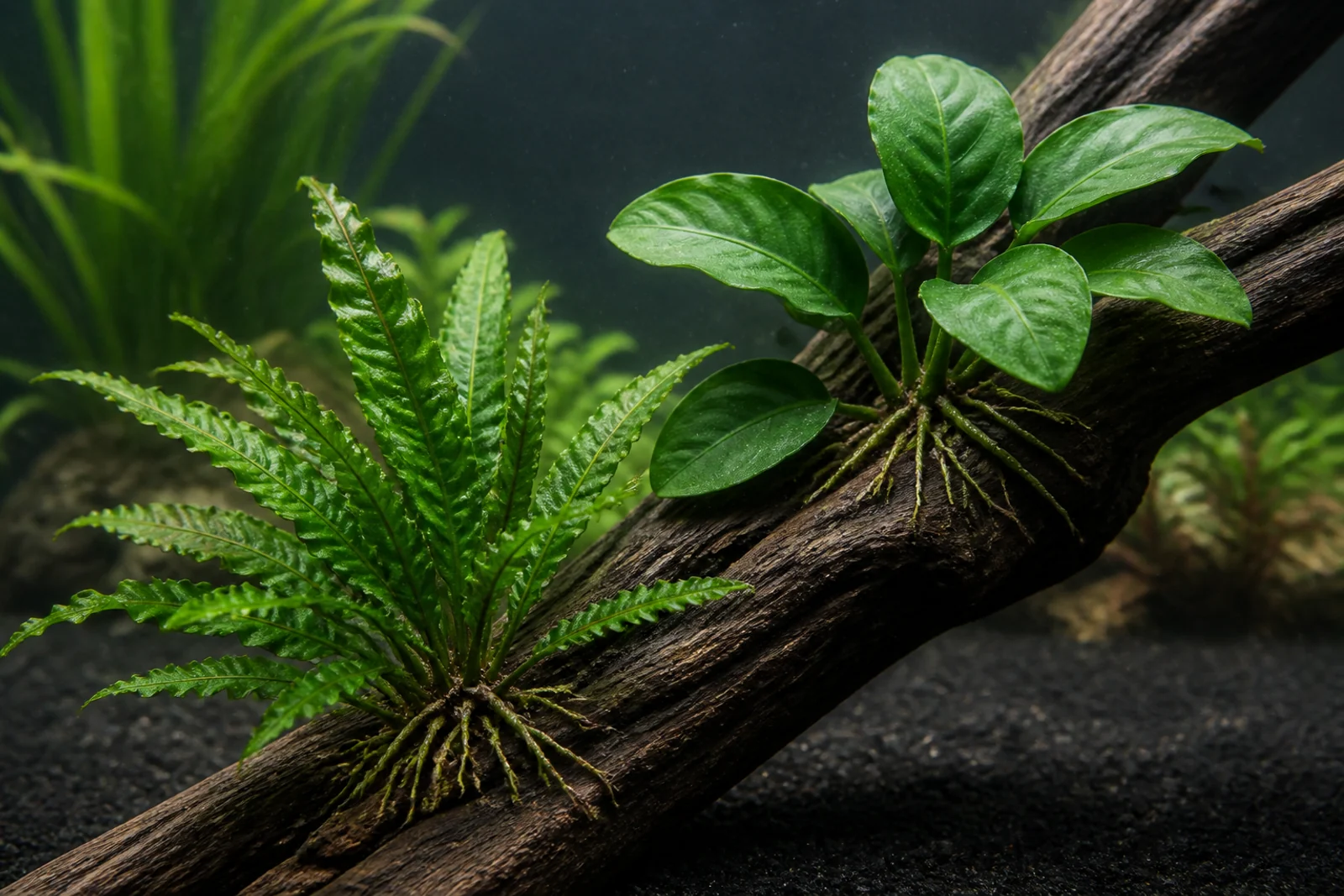
Anubias and java fern are the easiest starting plants and both attach to wood or rock rather than rooting in substrate. Do not bury their rhizomes; they rot.
If you use artificial plants, choose silk. Stiff plastic leaves tear betta fins, and those fins are large, heavy and easily damaged.
Step 4: fill and install equipment
Put a plate or your hand under the pouring water so you do not dig a crater in the substrate.
Fill, then add dechlorinator at the dose on the bottle. Then fit the heater and filter, and only then plug them in. Heaters run dry burn out, and some crack.
Set the heater to 26 °C, position the thermometer at the opposite end of the tank, and leave it a few hours before believing either of them.
Step 5: cycle it, empty
This is the step nobody at the shop mentions, and it is the one that decides whether your fish lives.
A cycled tank has grown enough bacteria to convert ammonia to nitrite and then to nitrate. Without them, waste accumulates and burns the fish.
Fishless cycling, in short:
- Add an ammonia source. Pure ammonia to about 2 ppm, or a small pinch of fish food left to break down.
- Test every day or two. Ammonia rises, then falls as nitrite appears.
- Nitrite rises, then falls as nitrate appears.
- The tank is cycled when a fresh dose of ammonia reads zero ammonia and zero nitrite within 24 hours.
This usually takes three to six weeks. Bottled bacteria can shorten it, sometimes considerably, but you still confirm with a test rather than with the label.
Do not do water changes during cycling unless nitrite goes off the chart. You are feeding a colony, not keeping a fish.
Step 6: the fish
Only now.
- Choose carefully. Alert, fins carried open, no white patches or ragged edges, responsive when you approach.
- Float the sealed bag for 15 to 20 minutes to match temperature.
- Add a little tank water to the bag every five minutes for about half an hour, so the chemistry shifts gradually.
- Net him in rather than pouring shop water into your tank.
- Leave him alone. Lights low, no food the first day, no visitors. A few days of hiding is normal after a move.
Step 7: the routine that follows
| How often | What to do |
|---|---|
| Daily | Look at the fish, check the thermometer, feed two to four pellets |
| Weekly | Test the water, change about 25 percent, wipe the glass |
| Monthly | Rinse filter media in removed tank water, never tap water |
Rinsing media under the tap kills the colony you spent weeks growing and returns the tank to an uncycled state.
Common setup mistakes
Buying the fish on the same day as the tank is the most common and the most damaging, because it removes any possibility of cycling first.
After that, in rough order of how often they come up: trusting the heater dial instead of a separate thermometer, leaving the tank open so the fish can jump out, doing full water changes that wipe out the cycle, and scrubbing everything when the tank looks dirty. Darkened media and a little biofilm are where the bacteria live, so cleaning them off undoes the work.
The last one is flow. A betta pinned against the glass, or unable to hold still anywhere in the tank, is fighting the current. Baffle the outflow or move to a sponge filter.
Where to go next
Once it is running, the numbers are what you actually manage week to week: what to test, what each reading means, and what to do about it.