
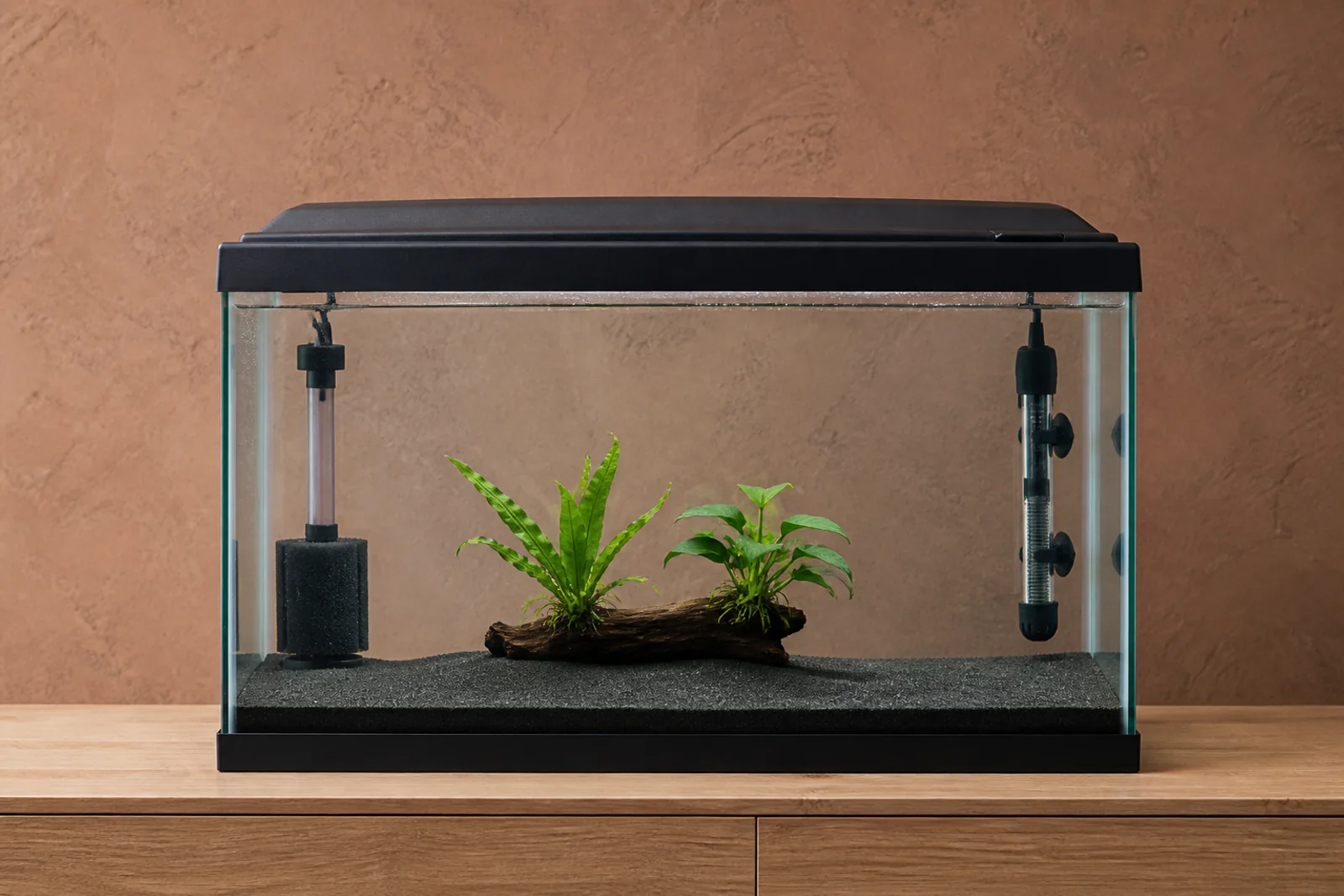
A betta needs nine things. Everything else in the aquarium aisle is optional, and most of it is decorative.
We are not printing prices, for the same reason the cost article does not: they differ by country, retailer and year, and a made-up total would be worse than none. What this page gives you is the list, the order of importance, and where a saving costs you more later.
The list
| Item | Notes |
|---|---|
| Tank, 5 gallons minimum | 10 is better and often barely more |
| Adjustable heater | Adjustable, not preset. Roughly 5 W per gallon |
| Thermometer | Separate from the heater |
| Sponge filter and air pump | Cheapest filtration and the gentlest |
| Lid | Bettas jump. Cut acrylic works |
| Substrate | Fine sand or small smooth gravel |
| Two hardy plants | Anubias and java fern last for years |
| Dechlorinator | Must handle chloramine as well as chlorine |
| Liquid test kit | Ammonia, nitrite, nitrate, pH |
That is a complete, working betta tank. Nothing is missing.
Where not to save
The tank. Anything under five gallons gets replaced, either because the fish struggles or because you learn better. Buying ten gallons once is cheaper than buying three then ten.
The heater. A preset heater that cannot be adjusted frequently sits at the wrong temperature, and cheap ones can stick on. This is the one component whose failure can kill a fish in a day.
The test kit. It is the item most often skipped on a budget and the one that decides whether the tank is cycled before the fish goes in. Strips are cheaper and cannot reliably distinguish zero ammonia from a harmful amount, which is the entire question you are asking them.
Where to save happily
Substrate. Plain sand from a hardware store, rinsed thoroughly, works as well as aquarium sand.
Plants. Anubias and java fern grow slowly and can be split. One purchase becomes several over a year, and aquarium societies and local keepers often give away cuttings.
The lid. A piece of cut acrylic with a notch for cables costs a fraction of a branded one.
The bucket, siphon and net. Any bucket that has never held detergent is fine.
Where second-hand works
Tanks. Clean with hot water, never detergent, then fill it outside and leave it a day to check the seals. Most second-hand tanks are sound and they are frequently free.
Filters, sponges, air pumps and lids are all fine used.
Heaters are the exception. Wear is invisible, the failure mode is severe, and the saving is small.
What to skip
Ornaments, which mostly tear fins or trap fish. Backgrounds. Air stones, since a sponge filter already moves the surface. Coloured gravel. Battery-powered gravel vacuums. Any conditioner promising stress coats or slime coats beyond dechlorination.
None of it changes whether the fish thrives, and every pound spent there is a pound not spent on a larger tank.
The order to buy in
Tank first, then heater and thermometer, then filter, lid and substrate, then dechlorinator and test kit, then plants.
Then run it empty for three to six weeks while it cycles. The fish is the last purchase, not the first, and buying it early is the one mistake that no budget fixes.
Where to go next
The setup guide covers assembling and cycling this in order. The cost article covers running costs, and the tanks guide covers what to look for if you have more to spend.