
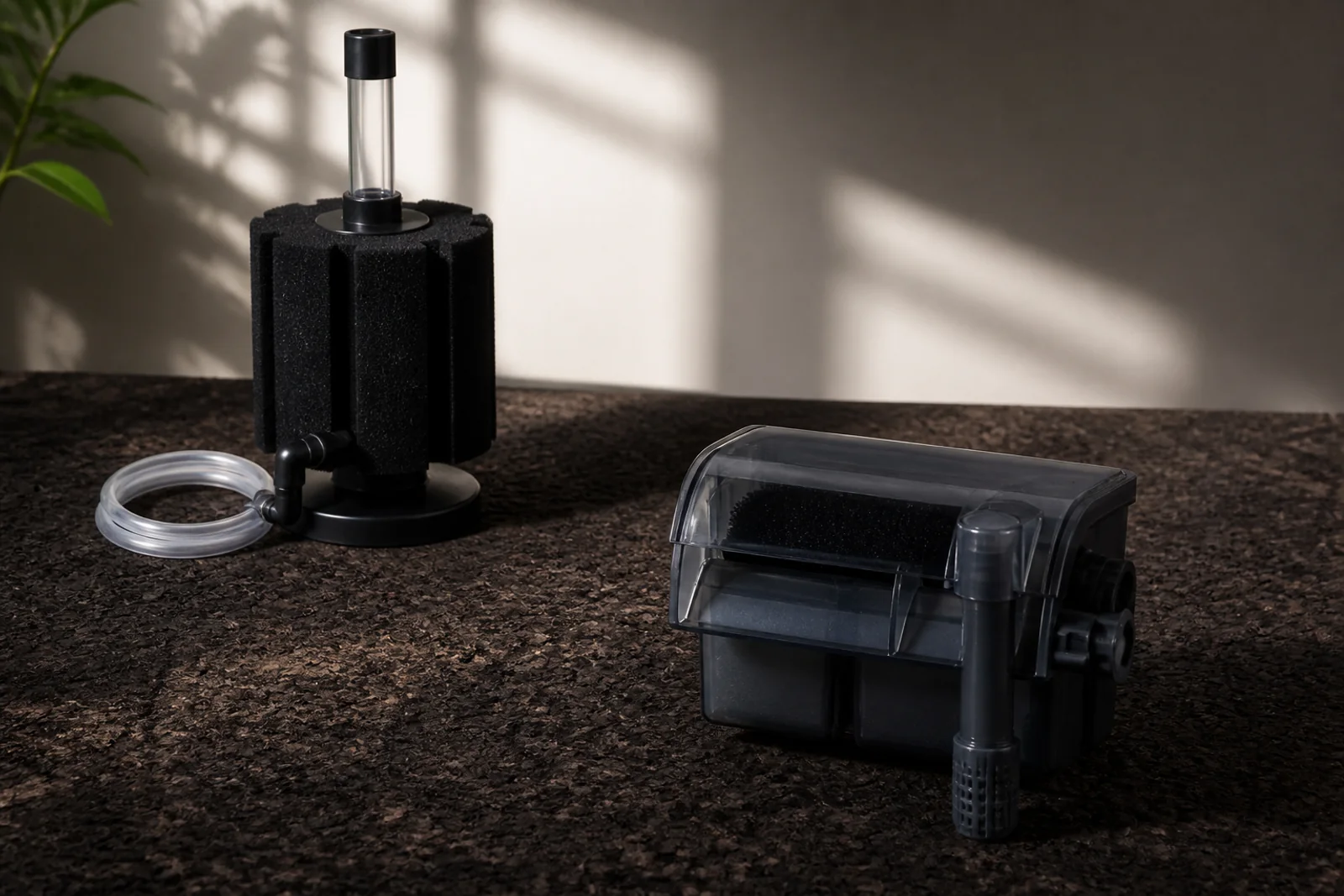
For most betta tanks, a sponge filter. It is cheaper, gentler and harder to get wrong, and it does the one job that matters as well as anything else.
What a filter is for
It houses bacteria. Those bacteria convert the ammonia your fish produces into nitrite and then into nitrate, and without them waste accumulates until it burns the fish.
Catching floating debris is incidental. A tank can look crystal clear and be lethal, and a slightly hazy tank with a mature colony can be perfectly safe. Judge a filter by what the test kit says, not by how the water looks.
The comparison
| Sponge filter | Hang-on-back | |
|---|---|---|
| Flow | Gentle, suits a betta as sold | Strong, usually needs baffling |
| Biological capacity | Ample for one betta | Ample |
| Mechanical filtration | Basic | Better at catching debris |
| Cost | Very low | Moderate |
| Extra equipment | Air pump and tubing | None |
| Noise | The pump, not the filter | The outflow, and impeller hum |
| Failure modes | Almost none | Impeller wear, clogging, priming |
| Fry and shrimp safe | Yes | No, needs an intake guard |
| Visual footprint | Visible in the tank | Hangs off the back |
Why sponge wins for most people
The flow suits the fish. A betta dragging heavy fins is a weak swimmer, and a sponge filter produces circulation without a current the fish has to fight.
There is no impeller, so there is no impeller to seize. The failure mode of a sponge filter is that the air pump stops, which is audible and cheap to replace.
It cannot trap a fish or a shrimp against an intake.
And it is the easiest thing in the hobby to keep a spare of. A second sponge running quietly in the tank is a ready-made cycled filter for a hospital tank the day you need one.
When a hang-on-back makes sense
You want the equipment out of the tank rather than in it. You have a ten gallon or larger with tank mates and want more mechanical filtration. You dislike the look of a sponge, which is a legitimate reason.
If you go this way, plan to reduce the outflow from the start. A sponge over the outlet, a plastic bottle cut into a deflector, or a purpose-made baffle all work. The test is the fish: it should be able to hold position anywhere in the tank without swimming hard.
The one to avoid
Cartridge-based filters, where the manufacturer expects you to throw away the media every month. The mature bacteria live in that media, so each replacement resets part of your cycle. It is a consumables business rather than a filtration design.
If you own one, keep the old cartridge in the tank next to the new one for a few weeks so the colony transfers, and consider replacing the whole unit with something that uses permanent media.
Maintenance for either
Once a month, squeeze or rinse the media in water you have just siphoned out of the tank, then put it straight back. Never under the tap.
Do not scrub it clean. Darkened, slightly slimy media is mature media, and the appearance you are tempted to remove is the colony doing its job.
Where to go next
The filter pillar covers whether a betta needs one at all and how filtration fits into the cycle. The baffling guide covers taming an outflow that is too strong.