
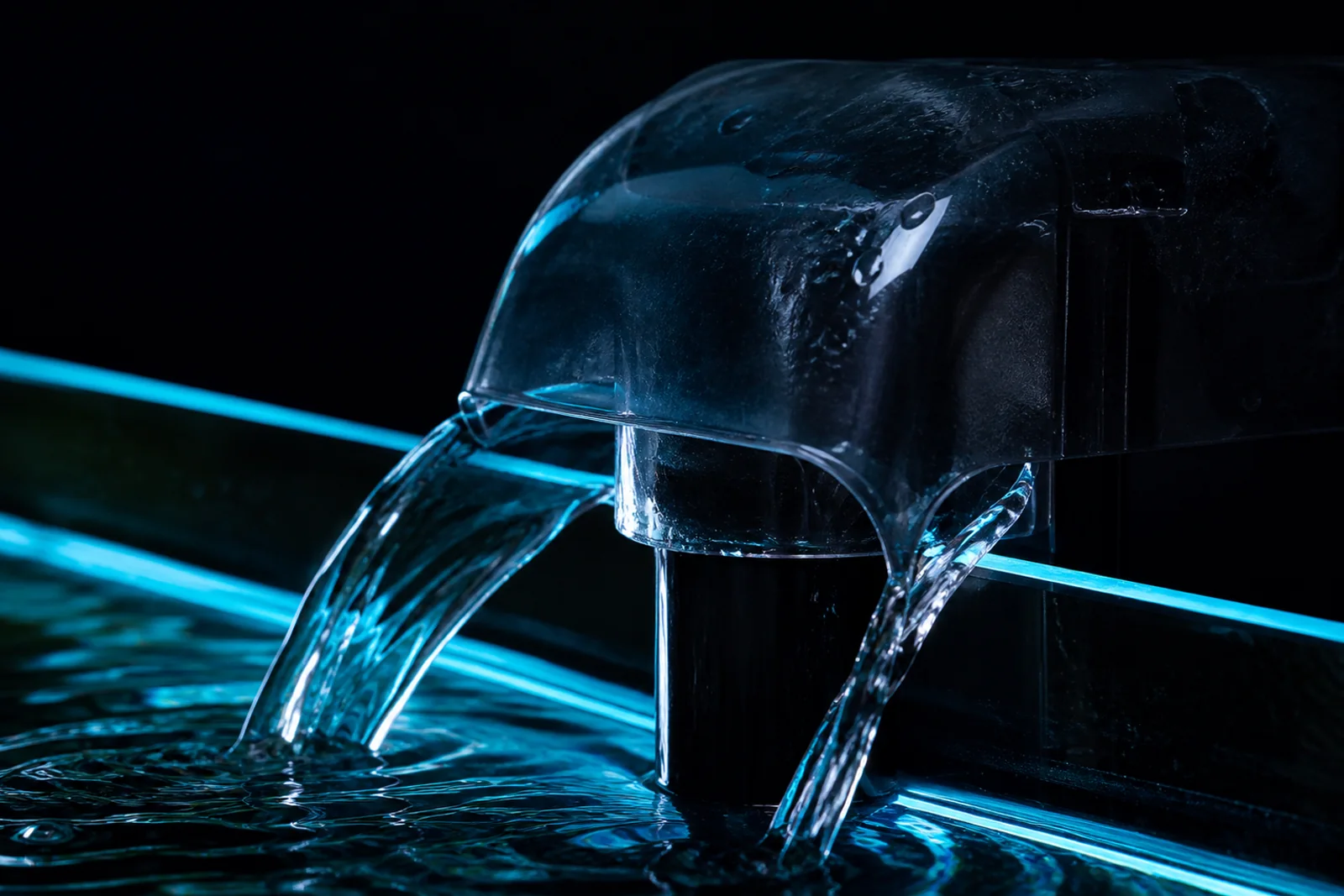
A betta dragging heavy fins is a weak swimmer in a species built for still water. Most aquarium filters are designed for fish that live in current. The mismatch is normal and it is easy to fix.
First, is it actually too strong
Watch the fish for a few minutes rather than guessing from how the water looks.
| Sign | Reading |
|---|---|
| Pushed sideways or backwards | Too strong |
| Cannot hold position where it wants to be | Too strong |
| Hides behind decor whenever it stops swimming | Too strong |
| Surface churning and rippling hard | Usually too strong |
| Fins constantly streaming behind it | Too strong |
| Swims through the current, then leaves it | Fine |
| Rests anywhere it likes | Fine |
A betta should be able to stop anywhere in the tank and stay there. If the only calm spot is behind the heater, the fish is living in a corner of its own tank.
Four fixes
The bottle baffle. Cut a plastic bottle so a section of it fits over the outflow, positioned so returning water hits the plastic and spreads sideways rather than driving down. Secure it with a clip or a rubber band. Free, five minutes, and the most widely used answer.
A sponge on the outlet. Push a small filter sponge over the outflow. The water comes through diffused, and the sponge becomes extra surface for bacteria. Tidier than a bottle and just as effective.
The flow control. Many hang-on-back units have a dial or slider. Use it if you have it, then check the fish rather than the setting.
Aim it at the glass. Turning the outflow so it hits the back or side pane breaks the jet before it reaches open water. Sometimes this alone is enough.
What not to do
Do not restrict the intake with tape or a half-closed valve. The impeller then works against resistance, which wears the motor and can burn it out.
Do not switch the filter off at night. The colony needs continuous flow through the media, and hours without it starts killing bacteria you spent weeks growing.
Do not remove the filter entirely and rely on water changes. That is an uncycled tank with extra steps.
Plants do this too
Tall stem plants along the back, a broad-leaved anubias in the current path, and floating plants across part of the surface all absorb flow and create calm pockets.
A heavily planted tank tolerates a filter that would be unusable in a bare one, and the fish gets cover as well. If you are already planning to plant, do that first and then see whether a baffle is still needed.
If nothing is enough
Some filters are simply oversized for a small tank. A sponge filter driven by an air pump produces gentle circulation by design and costs very little, and swapping is often less effort than fighting a unit that was never suitable.
Move the old media into the new filter so the colony comes with it.
Where to go next
The filter pillar covers what filtration is for and why the tank needs it. The sponge and hang-on-back comparison covers choosing between them, and the plants guide covers species that break up flow while you are at it.