
Two decisions that get made by default at the shop counter, and both are worth thinking about for a minute.
Lighting
Your betta does not need a light. It needs a day that is lighter than its night, and a curtained room already provides that.
The light is for the plants, and for you. Both are legitimate, and knowing that is what stops you buying a fixture the tank cannot use.
How long to run it
Six to eight hours a day, on a plug timer.
Consistency matters more than duration. A timer gives the plants a predictable photoperiod and the fish a predictable night, and it stops the pattern where the light stays on all evening one day and all night the next.
Running it longer does not grow better plants. It grows algae, because algae exploits excess light faster than anubias does.
Why dim suits the species
Bettas come from rice paddies, floodplains and vegetated canals: shallow, warm and shaded by growth above. A bright empty tank is the opposite of that, and a fish with nowhere to get out of the light stays on alert.
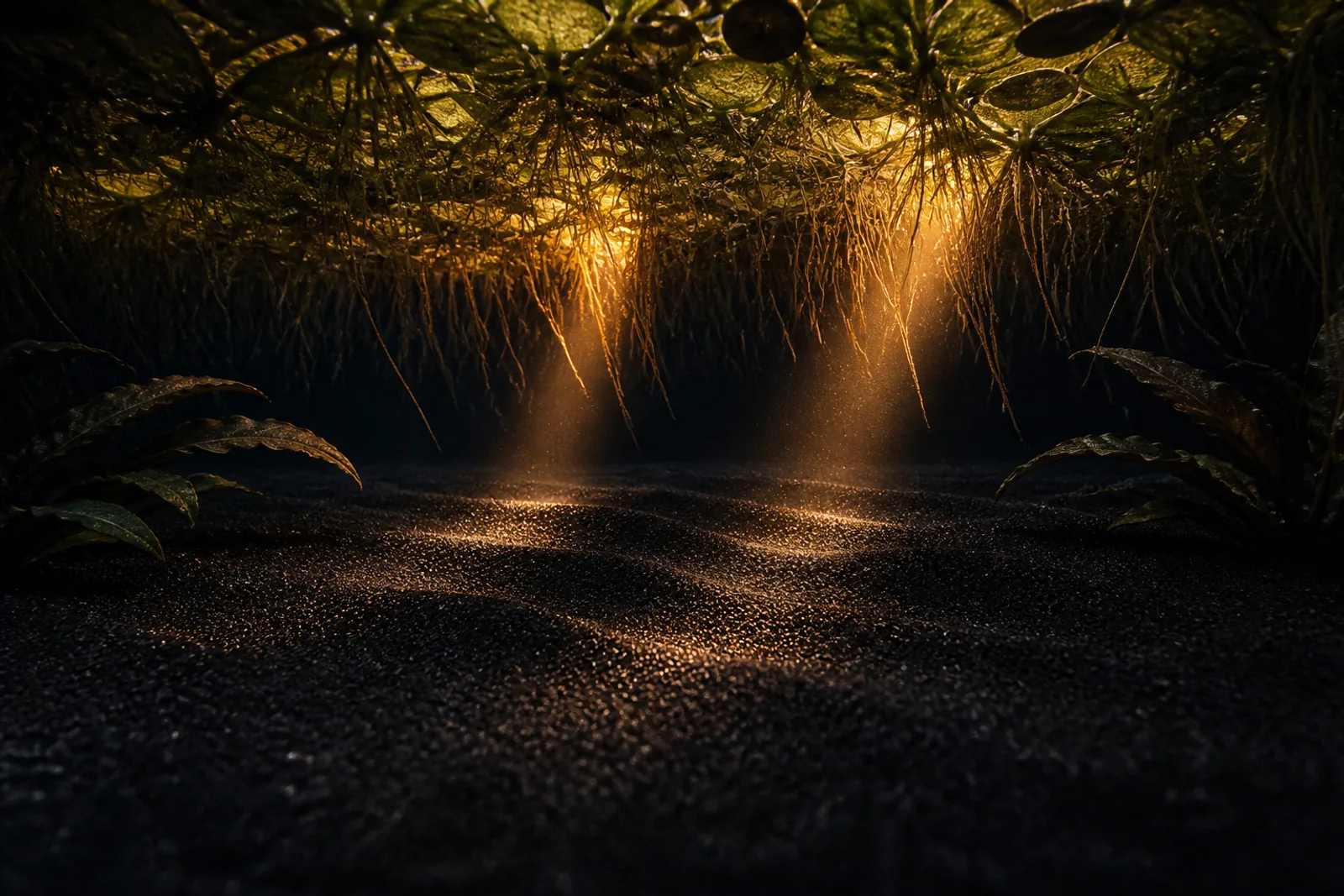
Floating plants are the fix. Frogbit or salvinia across half the surface cuts the intensity, throws dappled shadow, and gives the fish roots to sit among. It also slows algae, since the plants take the light first.
Leave part of the surface clear so the fish has an open route up to breathe.
What not to do
No light overnight. A betta needs real darkness to rest, and an aquarium lit around the clock is more disruptive than one that is off too often.
No blue moonlight mode left running. It is decorative and it interrupts the night.
Keep the tank out of direct sunlight, which drives both algae and temperature swings and is far stronger than any fixture you would buy.
Substrate
The job of substrate is to hold plants, house bacteria and not injure a fish that rests on it.
| Option | Verdict |
|---|---|
| Fine natural sand | Good. Easy to vacuum, plants root well, looks right |
| Small rounded gravel | Good. Slightly more food gets lost in the gaps |
| Aquarium soil capped with sand | Good for heavy planting, more work to set up |
| Coarse or sharp gravel | Avoid. Bettas lie on the bottom |
| Coloured or coated gravel | Avoid. Coatings chip and the look fights the fish |
| Bare glass | Fine for a hospital tank, poor for a display one |
Depth
Two inches. Slope it slightly higher at the back if you want depth in the view.
Deeper is not better. Thick substrate develops anaerobic pockets, and it is harder to vacuum, which is where the actual maintenance benefit of a shallow bed lies.
Rinse it first
Rinse sand or gravel in a bucket until the water runs almost clear. This takes longer than you expect and skipping it gives you a cloudy tank for a week and a filter full of dust.
Why texture matters for this species
A betta with heavy fins spends a lot of the day resting, often lying directly on the substrate or on a leaf just above it. A mid-water shoaling fish never touches the bottom and can tolerate gravel that a betta cannot.
That single behaviour is the whole argument for fine and smooth over coarse and angular.
Putting the two together
Fine dark sand under dim light with floating plants above is close to what the species evolved in, and it happens to make the fish look better than a bright tank with pale gravel does. Dark substrate makes colour read as saturated instead of washed out.
Where to go next
The setup guide covers where both of these fit in the build order, and the live plants guide covers the floating species that do the shading.