
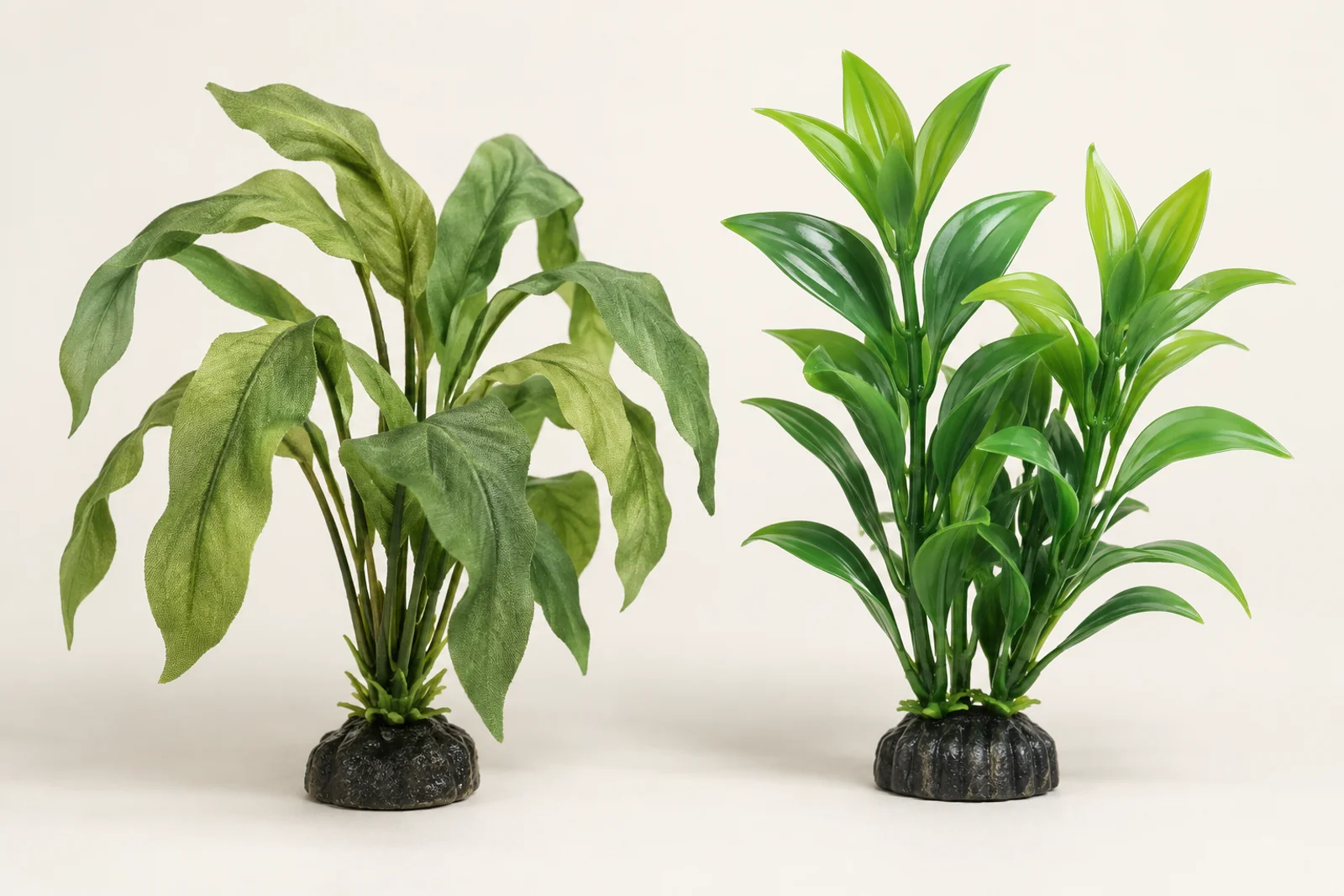
Silk, as a default. Not because plastic is automatically dangerous, but because silk removes the question, and a betta’s fins are not the place to find out you guessed wrong.
That said, “silk is safe, plastic is dangerous” is the kind of blanket rule that gets repeated in care sheets without much explanation, and it oversells what is really a manufacturing detail. Once you know what you are actually checking for, you can make plastic work too, or decide it isn’t worth the trouble and skip it.
Why “plastic” isn’t really the variable
The material people blame is plastic. The actual cause of most torn fins is narrower than that: a moulded seam, the thin ridge left where the two halves of an injection mould meet along a leaf or stem. Run a finger along a cheap plastic plant and you can often feel it before you see it.
A trailing fin does not need much of an edge to catch on. A halfmoon or crowntail drags several inches of delicate membrane through the water with every pass, and a seam that a stiffer fish would never notice is enough to snag one.
That is also why the advice is not simply “avoid plastic.” Well-finished plastic plants, with edges sanded or moulded smoothly, cause no more trouble than silk does. The label on the packaging tells you the material. It does not tell you whether the mould was finished properly.
How a bad seam actually gets there
Most aquarium plastic plants are injection moulded: liquid plastic is forced into a two-piece metal mould shaped like the leaf or stem, left to cool, and then the two mould halves are pulled apart. Where those halves meet, a thin ridge of excess plastic, called flash, is left behind along the edge.
A budget product skips the finishing step that removes that ridge, because it costs time on a production line making thousands of identical pieces. A better-made one is deflashed and sometimes polished, so the seam is smoothed down to nothing you can catch a fin, or a fingernail, on.
None of that is visible in a product photo or printed on a box. A plant that looks identical to another one online can be finished completely differently on the shelf, which is exactly why the test below matters more than the price tag or the brand name.
The comparison
| Silk | Plastic (untested) | Plastic (edge-tested) | Live | |
|---|---|---|---|---|
| Fin safety | High | Low, unpredictable | High | High |
| Cost | Moderate | Low | Low | Low to moderate |
| Realism | Good | Often poor | Often poor | Best |
| Maintenance | Occasional rinse | Wipe down | Wipe down | Trimming, dosing |
| Colour fastness | Can fade or bleed early on | Stable | Stable | Grows, does not fade |
| Weighting needed | Usually yes | Usually no | Usually no | Anchoring, not weighting |
| Algae growth | Can develop a film | Can develop a film | Can develop a film | Competes with algae |
The pantyhose test
Before any plastic plant goes in a tank with a long-finned betta, run this check.
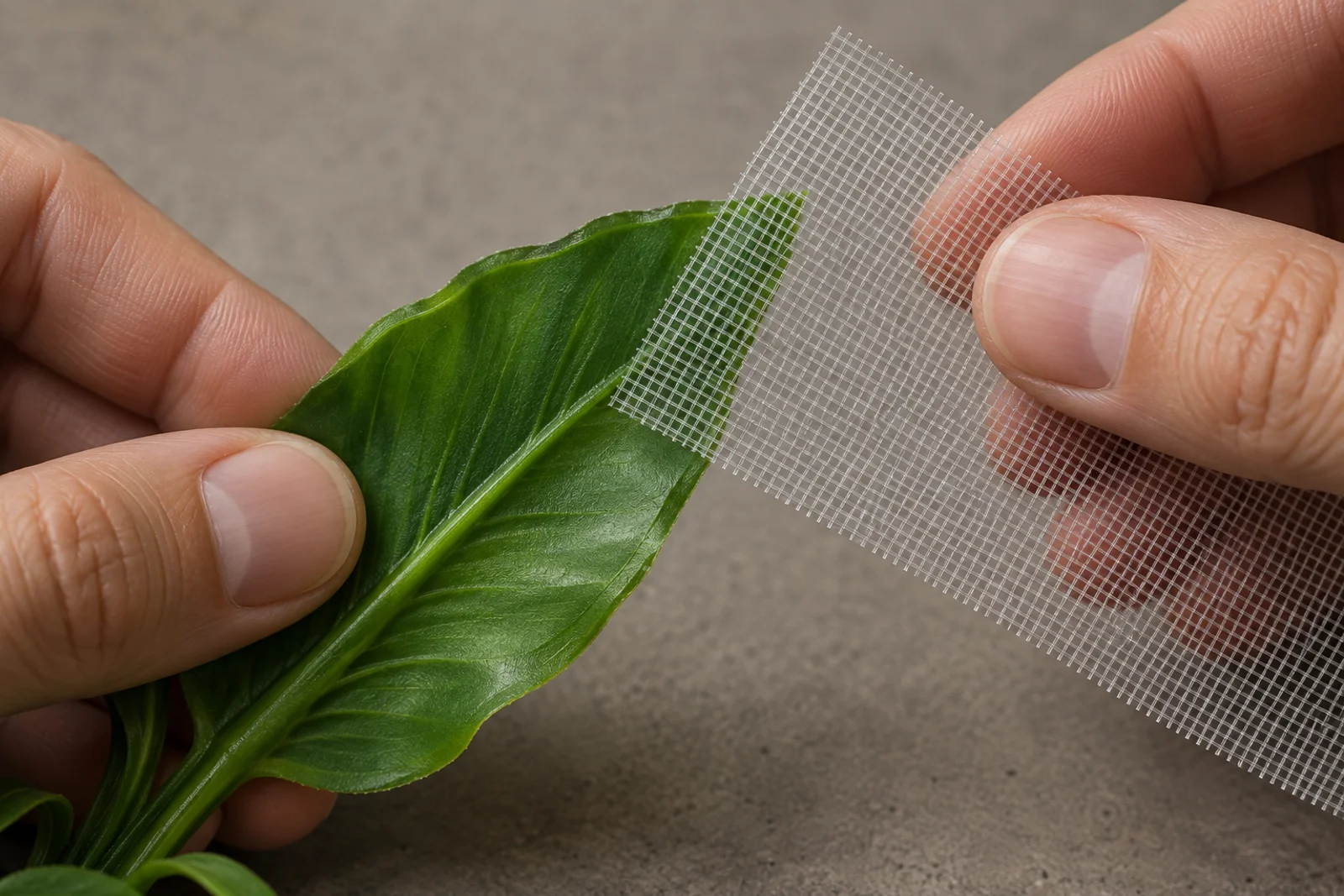
Stretch an old pair of pantyhose or a thin nylon stocking over your hand and drag it slowly along every leaf edge, stem, and the seam where the plant was moulded. If the fabric catches, snags a thread, or pulls at all, that spot will do the same thing to a fin, just slower and with more consequence.
Anywhere it catches, either sand the edge smooth with fine-grit sandpaper and retest, or leave the plant out of that tank. It takes about two minutes per plant and it is the only test that actually answers the question, rather than guessing from the price or the packaging.
Do this for every plastic item going into the tank, not only the ones sold as “plants.” Plastic ornaments, fake driftwood with moulded bark texture, and cave decorations are made the same way and carry the same seam risk. A betta that never goes near a background plant will still swim through a cave a dozen times a day, and that is where a missed seam usually does the damage.
Retest periodically, too. UV exposure and time make some plastics brittle, and an edge that passed the test when the plant was new can develop a rough spot months later as the material ages.
Where silk earns its reputation
The fabric itself has no moulding seam to catch on, because it is cut and stitched rather than injected into a mould. A fin can brush against a silk leaf repeatedly with nothing to catch, which is why it is the standard recommendation for halfmoon, crowntail, and other trailing-fin varieties.
Silk is not maintenance-free. New silk plants often float until they are weighted at the base, and being fabric, they trap a fine film of detritus that a live plant sheds and a smooth plastic one does not, so an occasional rinse in tank water keeps them from becoming a debris trap. Cheap dye can also bleed for the first water change or two, which is cosmetic rather than harmful, but worth knowing before you blame the water.
Weighting and arranging silk plants properly
New silk plants are lighter than water and tend to lean sideways or drift toward the surface until they are anchored properly, which is a common reason people give up on them after one attempt.
Most come with a weighted base, usually a lead-free ceramic or resin disc buried in substrate. Bury that base fully, not just balanced on top of the sand or gravel, and press the surrounding substrate down around it. For a taller plant, add a second anchor point, such as a small suction cup partway up the stem attached discreetly to the back glass, so the whole plant does not lean once it is full of water and slightly buoyant.
Rinse a new silk plant in tank-temperature water before it goes in for the first time. Manufacturing residue and loose dye come off in that first rinse rather than in the display tank.
Mixing materials in one tank
Nothing requires an all-or-nothing choice. A common, practical setup uses a handful of easy live plants in the foreground and midground, one or two silk plants for height and colour where live planting is harder to establish, such as directly under a bright fixture with too little substrate depth, and edge-tested plastic only for structural pieces such as caves and driftwood stand-ins.
That mix keeps the fin-safety question answered for anything the fish brushes against directly, while still giving you the reliability of plastic for pieces that need to hold their shape and position for years without maintenance.
Where plastic still makes sense
Background and midground bulk, where you want volume and colour without the cost or upkeep of live planting, and for tanks where a fish with short, sturdy fins is unlikely to catch on anything regardless.
A plakat, for example, carries far less trailing fin than a halfmoon and is a poor candidate for a fin injury from decor in the first place. For that fish, smooth plastic bought from a reputable aquarium brand and given a quick edge check is a perfectly reasonable, cheaper choice than a tank full of silk.
Where live plants remove the question
Live plants have no moulded seam because nothing was moulded. A handful of hardy, low-light species, the kind covered in the live plants guide, typically cost about the same as one good silk plant and never need an edge test at all.
The trade is real: live plants need light, occasional trimming, and some patience while they establish, against a fabric or plastic plant that arrives finished. For a keeper who does not want that trade, silk is the practical middle ground. For one willing to make it, live planting is the version of this problem that simply does not come up.
Cost over time, not just at checkout
The sticker price favours plastic, which is usually the cheapest option on the shelf. That comparison misses what happens over a year or two of ownership.
Cheap plastic that was never edge-tested and does cause damage costs you a fin rot treatment, a course of aquarium salt, and the stress of a sick fish, which dwarfs the few dollars saved. Cheap plastic that was tested and is fine costs nothing extra and lasts indefinitely, since it does not fade, rot, or need replacing.
Silk costs more upfront and, being fabric, eventually shows wear: colours can dull under strong lighting after a year or two, and the weighted base can work loose and need re-anchoring. Replacing one silk plant every couple of years is still cheaper than one round of fin rot treatment.
Live plants are frequently the cheapest option of all over time, since a single low-light stem plant will propagate into several more without buying anything further, at the cost of the small ongoing effort of trimming.
Common mistakes people make switching materials
Buying silk and leaving it unweighted, so it drifts into the filter intake or the heater and gets mistaken for a bad product when the actual problem was setup.
Assuming an expensive plastic plant is automatically safe because of the price. Cost correlates loosely with finishing quality, not perfectly, and a mid-range product can still ship with a rough seam.
Testing a plant once when new and never again. Plastic that has been under aquarium lighting for a year is not the same material it was on day one.
Blaming the water or the food when a fin starts fraying, when a walk around the tank checking every hard surface for a snag would have found the actual cause in minutes.
Matching the material to your fish’s fin type
The risk is not evenly spread across every betta. Fin length and structure change how much surface area is trailing through the water at any given moment, and that changes how much margin for error the decor needs to have.
| Tail type | Trailing fin | Practical caution level |
|---|---|---|
| Halfmoon, rosetail | Very long, wide spread | High, silk or tested plastic only |
| Veiltail | Long, flowing | High, silk or tested plastic only |
| Crowntail | Long, but spiked rather than solid | Moderate to high, edges can catch the rays |
| Delta, super delta | Long, moderate spread | Moderate |
| Plakat | Short, close to the body | Lower, though untested edges are still worth avoiding |
A plakat owner who runs the pantyhose test out of habit rather than necessity is not wasting time, since a fish can still brush a fin against decor while resting or exploring. It is simply a lower-stakes check for that fish than it is for a halfmoon carrying several inches of unsupported fin.
What to actually do
Check every plastic decoration already in the tank with the pantyhose test, not just new purchases. Replace or sand anything that snags. For new additions to a tank with a long-finned betta, default to silk or a plant you have already tested, and treat “plastic” alone as neither a pass nor a fail.
Where to go next
The live plants guide covers species that suit a low-tech betta tank if you decide to skip synthetic decor altogether. The tank lid and jumping guide covers the other common source of fin and body damage, which is decor with sharp edges near the surface rather than in the water column.