
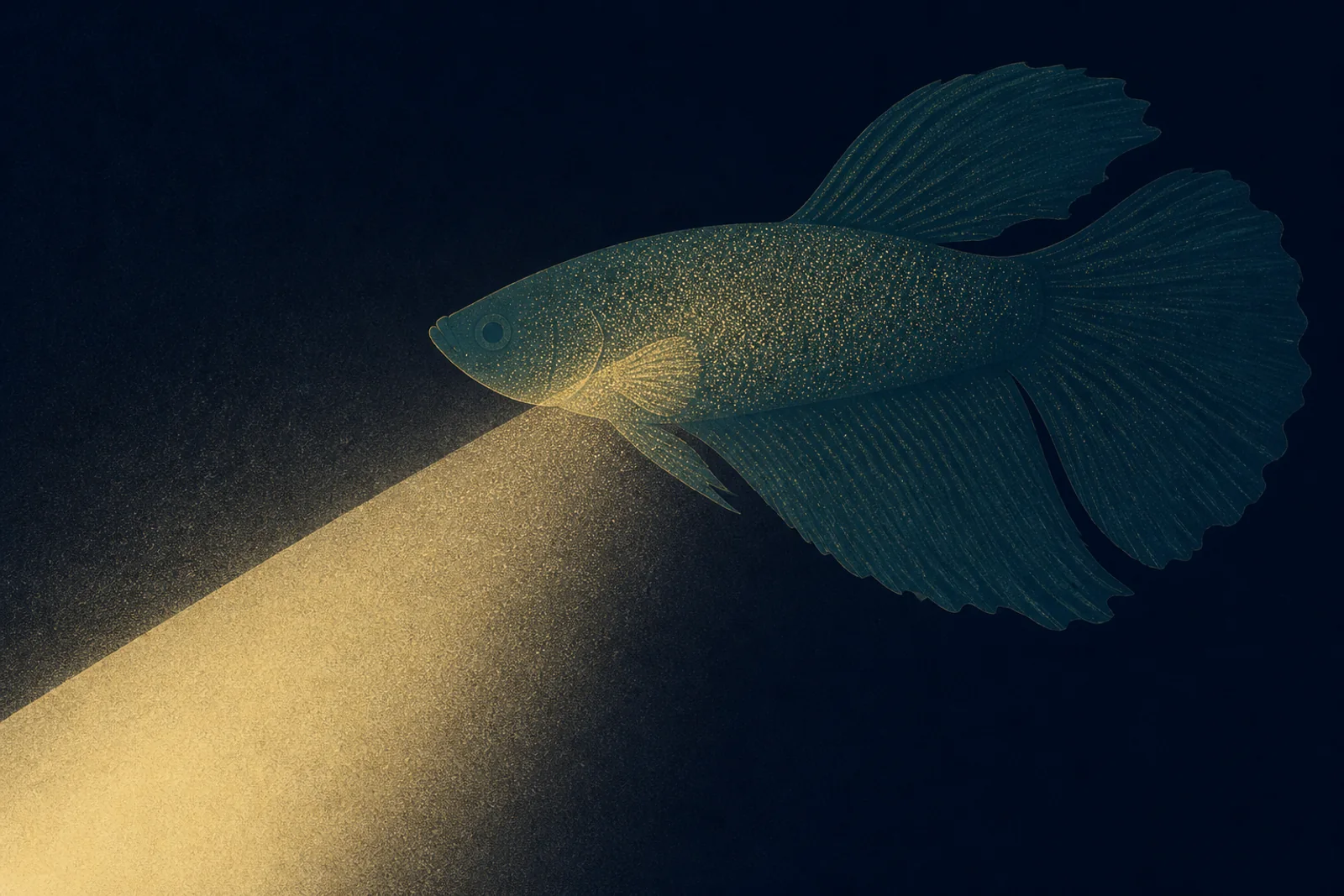
Velvet is the illness people find late, and they find it late because it is genuinely hard to see. By the time the coating is obvious under tank lighting, the infection has usually been running for days.
How to actually look for it
Turn the aquarium light off. Darken the room. Shine a torch along the flank of the fish at a shallow angle, almost parallel to the body, rather than pointing at it.
Velvet shows as a fine even dust with a gold or rust cast, catching the light like powder. Under ordinary front lighting the same fish can look completely normal.
If you can count the spots, it is not velvet.
Velvet against white spot
| Velvet | White spot | |
|---|---|---|
| Appearance | Fine even dust, gold or rust | Distinct raised dots, white |
| Countable | No | Yes |
| Visible under tank light | Often not | Usually yes |
| Speed | Faster | Slower |
| Light matters | Yes, keep the tank dark | No |
The last row is the practical difference. Both are parasites with a free swimming stage, both need the whole tank treated, and both need treatment continued past the point where the fish looks clean. Only one of them cares about light.
The signs that come first
Velvet announces itself through behaviour days before appearance.
Flicking and rubbing against decor and substrate. Fins clamped tight. Gill movement faster than usual, sometimes with the fish hanging near the surface. Appetite falling away. A fish doing these things with no visible cause is worth the torch test.
Treating it
- Test the water. An outbreak follows a stressor, and poor water is the usual one.
- Turn the light off and keep the tank dark for the whole course. Cover it if the room is bright.
- Remove activated carbon from the filter, or it will strip the medication out.
- Remove snails and shrimp, which most treatments harm.
- Treat the entire tank with a product intended for velvet, at the dose on its label. Do not scale a dose from elsewhere and do not combine products.
- Continue for the full course stated, past the point where the fish looks clear. The stage you cannot see is the one that restarts the infection.
- Keep feeding, lightly.
If the fish is breathing hard, if the gills are affected, or if the full course produces no change, contact an aquatic veterinarian. Velvet can kill quickly and gill involvement is the point at which time runs short.
Where it came from
Nearly always a new fish, plant or a volume of shop water added without quarantine. The parasite is frequently present at low levels and becomes an outbreak when a fish is chilled, stressed or living in poor water.
Two weeks of quarantine for anything new prevents most of this, and it is far less work than treating a display tank.
Where to go next
The diseases pillar covers telling the presentations apart, the white spot guide covers the condition velvet is most often confused with, and the quarantine guide covers the tank that stops it arriving.