
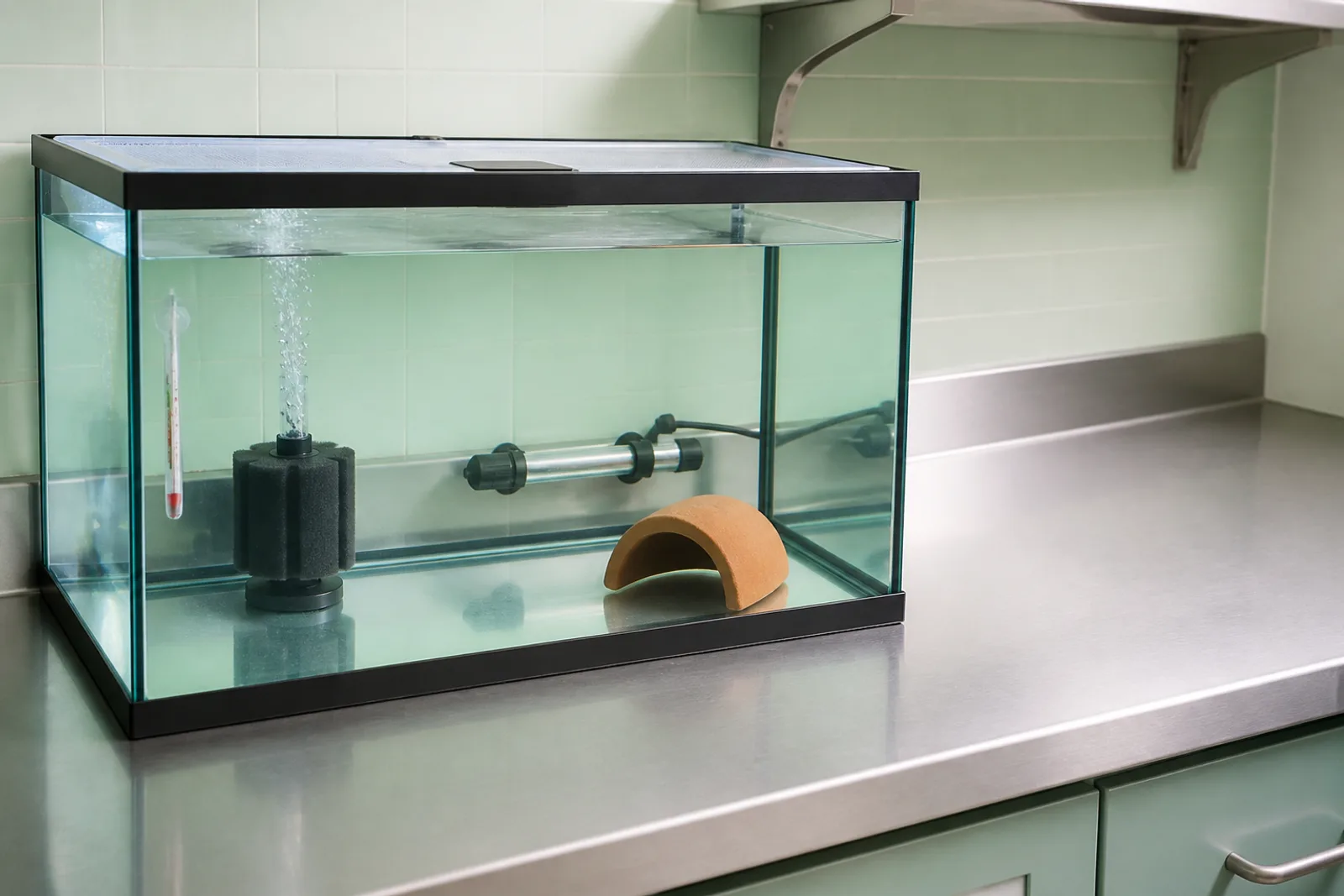
A quarantine tank is a plain five gallon box that sits empty most of the year and earns its cost the week a fish gets sick.
It has two jobs. It holds a new fish long enough for problems to show themselves, and it becomes the hospital tank when you need to medicate without dosing a display tank full of plants, snails and a bacterial colony.
What it needs
| Item | Notes |
|---|---|
| Tank, 5 gallons | Bare bottom, no substrate |
| Sponge filter | Ideally one kept running in the main tank |
| Adjustable heater | Small, matched to the volume |
| Thermometer | Separate from the heater |
| Lid | Bettas jump, and a sick one still jumps |
| One cave or a silk plant | Cover reduces stress. Easy to sterilise |
| Its own net, siphon and bucket | Never shared |
No substrate, no live plants, no decorative wood. Everything in there needs to be either disposable or scrubbable, and porous materials hold both pathogens and medication.
The sponge filter habit
The awkward part of a quarantine tank is that it needs a cycle, and you need it at short notice.
The answer is to keep a spare sponge filter permanently running in your main tank. It sits in a corner doing nothing visible and growing a bacterial colony. When you need quarantine, move that sponge into the fresh tank and it is cycled on arrival.
This one habit converts a three week wait into ten minutes, and it is the reason experienced keepers can respond to a sick fish the same day.
Running it for a new fish
- Fill with dechlorinated water at the same temperature as the shop bag if you can.
- Move the seeded sponge across, fit the heater, and set it to 26 degrees Celsius.
- Acclimate the new fish and net it in. Do not add shop water.
- Two weeks minimum. Four is better.
- Feed normally and look at the fish daily. Fin carriage, appetite, breathing rate, spots or patches.
- Test ammonia every day or two. A bare tank with one fish is small and simple, so readings move fast.
- Change 25 to 50 percent of the water every few days.
- If anything appears, treat it here, and restart the two weeks once it clears.
Only then does the fish go into the main tank.
Running it as a hospital tank
Same setup, different reason.
Move the sick fish across, bring the seeded sponge with it, and treat according to the label on whatever product you are using. A bare tank of known volume means the dose is right. Removing carbon from the filter means the dose stays in the water.
Two cautions. If the illness turns out to be water quality in the main tank, moving the fish treats the symptom and leaves the cause, so test both tanks. And if the main tank is genuinely infected, the fish returning to it will be reinfected, so the display tank needs its own treatment or fallow period.
Sterilising between uses
Empty it, scrub with hot water, and let everything dry completely. Drying kills most freshwater pathogens. Some keepers use a dilute bleach soak followed by a very thorough rinse and a dechlorinator dose; if you do, make certain nothing smells of chlorine before it goes near a fish.
Do not sterilise the sponge filter. That goes straight back into the main tank to carry on doing its job.
Where to go next
The diseases pillar covers what you are watching for during those two weeks, and the selection guide covers how to avoid buying a sick fish in the first place.