
Our health guides describe what to do once something has gone wrong. This one describes how to stop needing them.
The useful thing to understand about betta disease is that the pathogens are usually already in the tank. White spot, columnaris and the bacteria behind fin rot sit at low levels in ordinary aquariums, held in check by a fish whose immune system is working. An outbreak is generally not an arrival. It is a fish that stopped coping.
That reframes prevention. You are not keeping organisms out. You are keeping the fish able to handle them.
The five habits
Hold the temperature steady
A betta below about 24 degrees Celsius has a suppressed immune response. Repeated chilling, which is what an undersized or absent heater produces overnight, does more damage than a constant slightly imperfect temperature would.
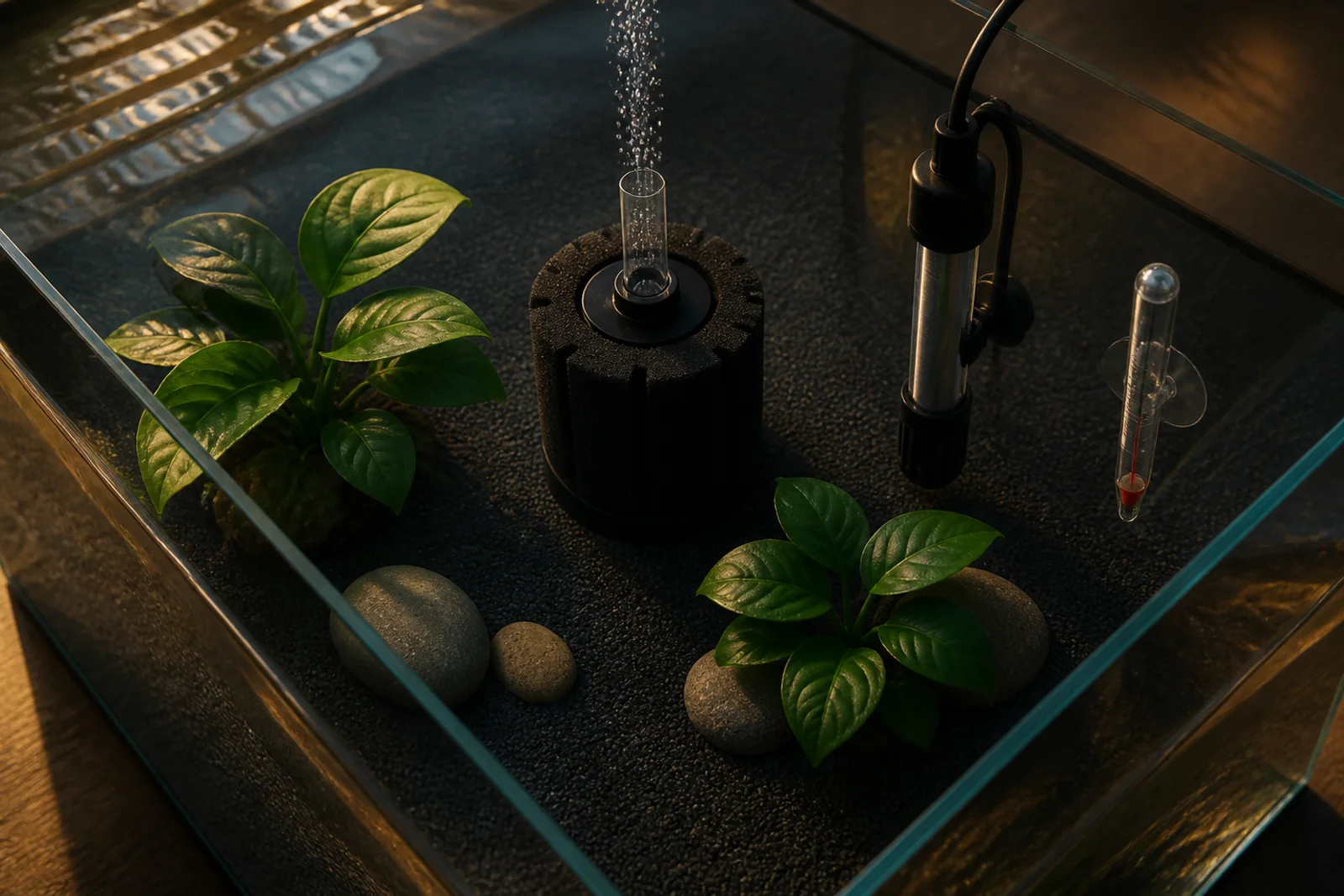
Use an adjustable heater sized to the tank and a separate thermometer, because heater dials are frequently wrong. Read the thermometer, not the dial, and replace the heater when it starts drifting rather than when the fish is already unwell.
This is the highest-value item on the page and the cheapest.
Keep ammonia and nitrite at zero
Ammonia burns gill tissue and fin edges. A fish with burned gills is a fish that cannot fight anything else off, which is why fin rot so often shows up in tanks that were never cycled.
Cycle the tank before the fish goes in, test weekly, change a quarter of the water a week, and never rinse filter media under the tap.
Quarantine everything new
Two weeks minimum in a separate tank, four if you can. This applies to fish, and also to plants and snails, which arrive in water from a shop system.
Never pour shop water into your display tank. Net the fish across instead.
Keep equipment separate
One net, one siphon and one bucket per tank, labelled. A shared net carries pathogens straight across and undoes the quarantine you just spent a fortnight on.
If you only have one set, work on the healthy tank first and let everything dry completely afterwards. Drying kills most freshwater pathogens.
Feed small and varied
A quality carnivore pellet as the staple, two to four pellets twice a day, with frozen foods once or twice a week for variety.
Overfeeding is a water quality problem wearing a nutrition costume: uneaten food breaks down into ammonia, and a fish carrying too much food is a fish with a digestive problem waiting to happen.
Reducing stress, specifically
Stress is not a mood. It is a measurable physiological state that costs the fish immune capacity, and in a tank it comes from identifiable things.
| Source | Fix |
|---|---|
| Too much flow | Baffle the outflow, or use a sponge filter |
| No cover | Plants, wood, a cave. A fish that cannot hide stays alert |
| Reflection on the glass | Raise room light, add a background, plant against the glass |
| Constant rearranging | A betta maps its territory. Leave the layout alone |
| Unsuitable tank mates | Fin nippers and anything that competes for the surface |
| Bright bare tank | Floating plants dim the light, which suits the species |
| Tank too small | Under five gallons, every other problem gets worse faster |
What is not prevention
Dosing a healthy fish with antibiotics selects for resistant bacteria and leaves you nothing to escalate to when a real infection appears. It also stresses the fish you were trying to protect.
Permanently salted water is a low-grade load on the kidneys of a freshwater fish, with no benefit while nothing is wrong.
Cleaning everything thoroughly is the counterintuitive one. Scrubbing biofilm off surfaces and replacing darkened filter media removes the bacterial colony that keeps ammonia at zero, so a visibly clean tank and a healthy tank are different things.
Dechlorinator is necessary. The additional stress-relief claims printed on the bottle beside it are not what keeps a fish well.
The habit that catches everything else
Look at the fish every day.
Fin carriage, appetite, breathing rate, position in the tank. You are not inspecting for disease, you are building a baseline, and the value of a baseline is that a deviation is obvious on day one.
Nearly every article in our health section opens with a symptom that had been developing for a week before anyone noticed. Thirty seconds a day is what closes that gap.
Where to go next
The diseases pillar covers identification once something does appear, and the quarantine guide covers the separate tank that two of these five habits depend on.