
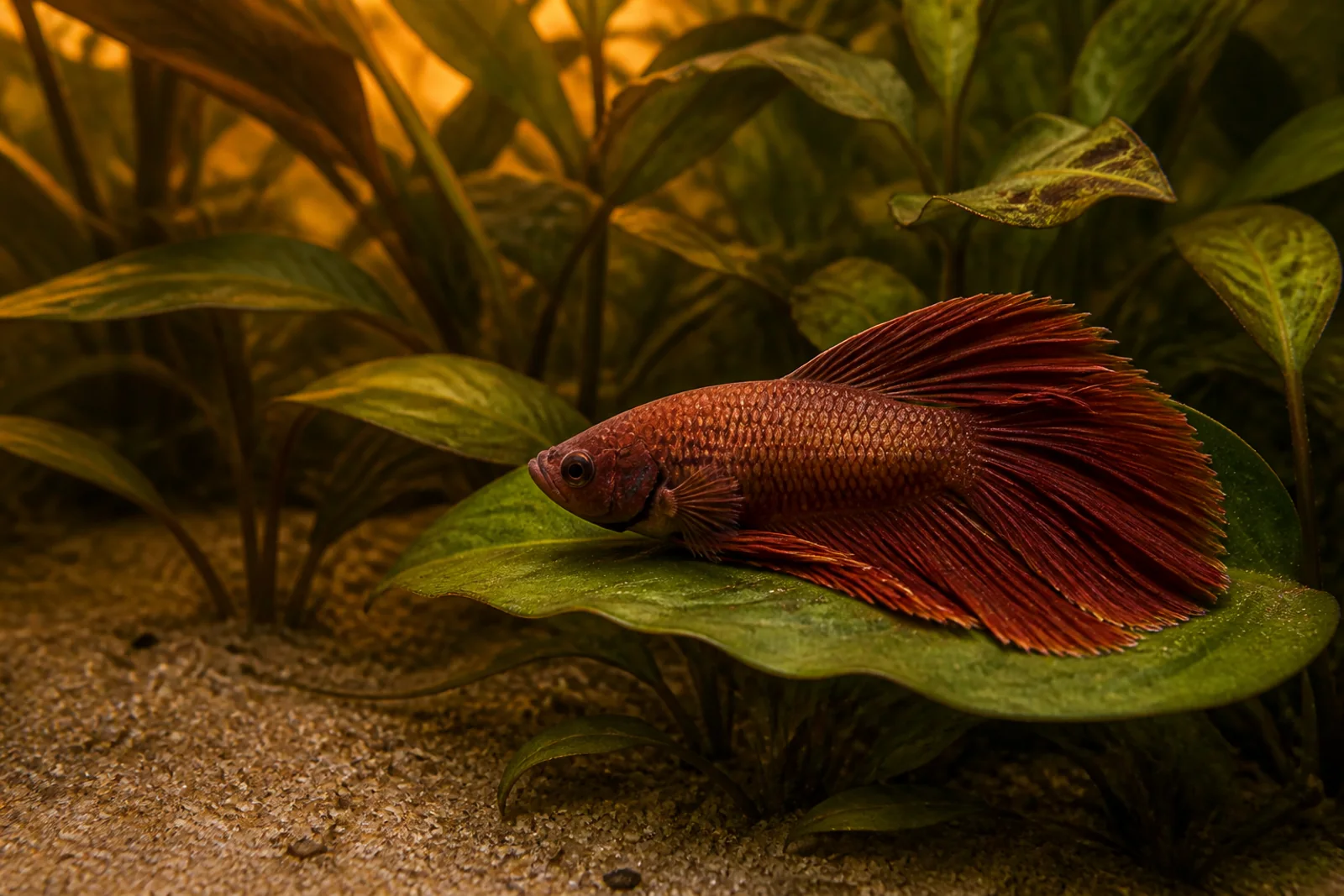
Bettas sleep lying down. They rest on leaves, wedge themselves behind the filter, and lie flat on the substrate for long stretches. A betta on the bottom is doing something normal far more often than people fear.
The position is not the signal. What the fish does from that position is.
Watch for three minutes before doing anything
| Still normal | Worth acting on |
|---|---|
| Rises to the surface for air at a steady rhythm | Struggles to get up, or gives up partway |
| Responds when you approach the glass | Ignores you entirely |
| Fins carried open | Fins clamped tight against the body |
| Ate at the last feed | Refusing food for more than a day |
| Settles, moves, settles again | Has not moved position all day |
| Upright | Lying on its side, or rolling |
A fish showing the left column is resting. A fish showing the right column has a problem, and the next two checks find it most of the time.
Check the thermometer
Below about 24 degrees Celsius a betta slows down, stops eating and settles on the bottom. It is the single most common cause of this complaint, and the most common reason is a heater that has failed, is undersized, or was never fitted.
Read the thermometer, not the heater dial. If it is cold, raise the temperature gradually over several hours rather than all at once, and expect the fish to pick up within a day or two.
Test the water
Ammonia and nitrite at zero, nitrate under about 20 ppm. Any reading above zero on the first two produces exactly this picture, often with gasping at the surface, and the fix is a 50 percent water change repeated daily until it clears.
Between temperature and water quality you have covered most cases. Do these two before considering anything else, and certainly before medicating.
When it is urgent
Three situations need action rather than observation.
The fish cannot reach the surface. A betta breathes air, so a fish that tries and fails is in real trouble. Lower the water level so the trip is shorter while you work out why.
The fish lies on its side or cannot stay upright. That points at a swim bladder problem or advanced weakness rather than at rest.
Breathing is fast and laboured, or the gill covers are red. That suggests ammonia or a gill problem, and it will not wait.
When it is old age
A betta of three years or more rests far more than a young one. It will spend much of the day on the bottom or on a leaf just above it, move slowly, and still eat.
If the water tests clean, the temperature is right and the fish is simply old, this is not a disease and there is nothing to treat. Lower the water level slightly so the trip to the surface is easier, add a leaf or a hammock near the top, and keep the tank calm.
What not to do
Do not medicate on this symptom alone. It identifies nothing, and a course of antibiotics on a fish that is merely cold makes things worse.
Do not do a full water change to be safe. Large sudden changes shock a fish that is already struggling.
Do not keep prodding the fish to see if it moves. A resting betta that is repeatedly disturbed becomes a stressed one.
Where to go next
The diseases pillar covers the specific conditions this can turn out to be. The clamped fins guide covers the other broad distress signal, and the swim bladder guide covers a fish that cannot hold itself upright.