
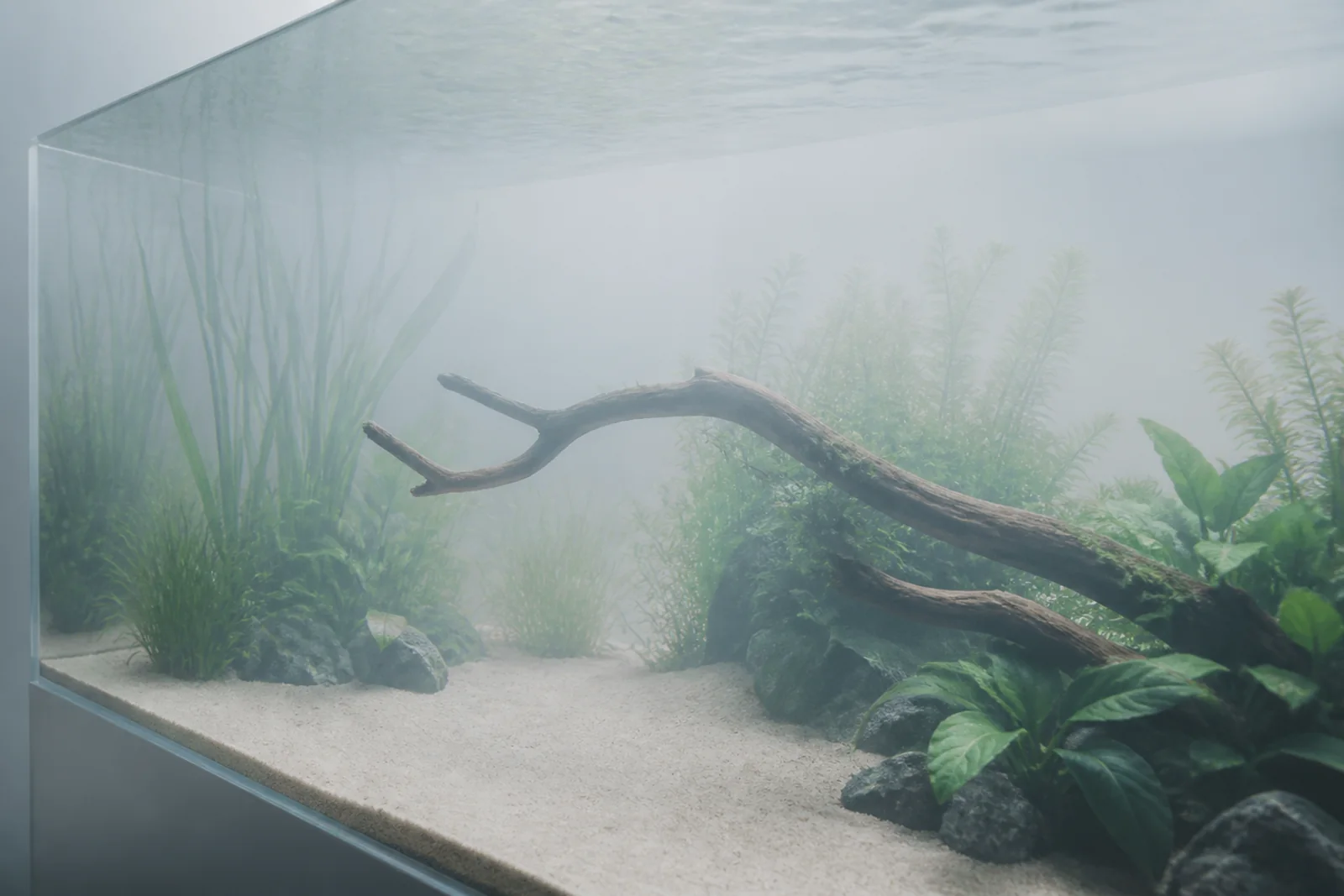
Cloudy water is a symptom with three common causes, and the colour tells you which one you have.
Before any of it: cloudiness is not a measure of safety. A tank can be perfectly clear and full of ammonia, and a hazy tank can be entirely fine. Test first.
Reading the colour
| Appearance | Cause | Response |
|---|---|---|
| White or milky, new tank | Bacterial bloom | Leave it alone. It clears |
| Grey or brown, straight after setup | Unrinsed substrate dust | Filter will catch it. Rinse better next time |
| Green | Algae | Cut light, check feeding |
| White, established tank | Something changed. Test and investigate | Find the trigger |
| Tea coloured, not cloudy | Tannins from wood or leaves | Harmless and often deliberate |
Bacterial bloom
The classic new-tank haze. A population of free-floating bacteria multiplies faster than the surfaces can hold them, and the water goes milky.
It is harmless in itself, and it clears in a few days to a couple of weeks as the colony settles onto the filter media and substrate where it belongs.
The instinct is to do large water changes until it goes. That tends to prolong it, because you are removing the bacteria that are in the process of establishing. Leave it, keep testing, and let it resolve.
The exception is a bloom in a tank with a fish and a positive ammonia reading. Then you change water for the ammonia, not for the appearance.
Green water
Free-floating algae, and the cause is nearly always light.
Direct sunlight on the tank is the biggest single driver and it is worth fixing permanently rather than compensating for. After that, an aquarium light left on too long, ten or twelve hours instead of six to eight.
Excess nutrients feed it, which usually means overfeeding or nitrate that has been allowed to climb.
The fix is to reduce light with a timer, move the tank out of the sun, feed less, and change water on schedule. Fast-growing and floating plants help by taking the same nutrients the algae wants.
Substrate dust
Grey or brown cloud within hours of setting a tank up, or after disturbing the substrate heavily during maintenance.
The filter will clear it over a day or two. The lesson is for next time: rinse sand or gravel in a bucket until the water runs almost clear, which takes longer than anyone expects.
Cloudy in an established tank
This one is worth investigating rather than waiting out, because a stable tank going cloudy means something changed.
Test the water first. Then look for the trigger: overfeeding, a dead snail or fish out of sight, a filter that stopped or was rinsed under the tap, a decoration that has started breaking down, or a large substrate disturbance.
What not to do
Do not use a clarifier. It clumps particles for the filter to remove, which changes the appearance and leaves the cause exactly where it was. In a new tank it also works against the bloom that is part of the tank establishing.
Do not do a full water change to reset it. That removes the bacterial colony and sets the tank back further than the cloudiness ever would have.
Do not judge water quality by clarity. That is the habit this whole article exists to break.
Where to go next
The water parameters guide covers what to test and what each reading means. The new tank syndrome article covers the cycling period a bloom usually belongs to, and the lighting guide covers the photoperiod that keeps algae in check.