
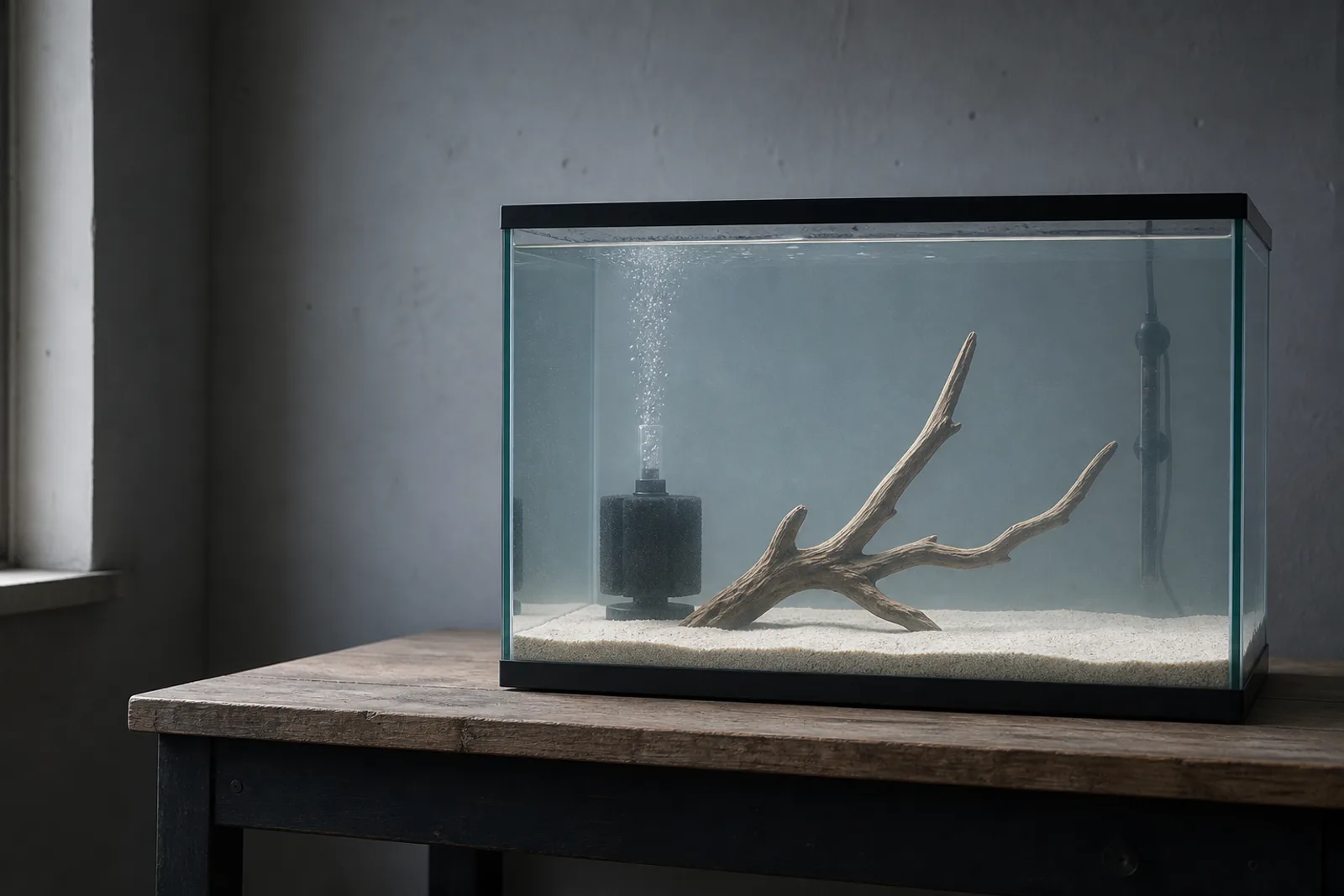
New tank syndrome is a polite name for ammonia poisoning. A new aquarium has no bacterial colony, so the waste the fish produces has nowhere to go, and it accumulates in water that looks perfectly clean.
This is the most common way a first betta dies, and the tank looks fine the whole time.
What is happening
A fish excretes ammonia continuously. In an established tank two groups of bacteria convert it, first to nitrite and then to nitrate, within hours.
Those bacteria take weeks to establish. Until they do, ammonia climbs. Then the first group arrives and ammonia falls while nitrite climbs, which is just as toxic. Then the second group arrives and the tank is cycled.
The dangerous window is the whole of that sequence, and it is invisible. Ammonia is colourless and odourless at the concentrations that harm fish.
Recognising it
| Sign | What it means |
|---|---|
| Gasping at the surface | Often nitrite, which blocks oxygen transport |
| Sitting still on the bottom | Non-specific stress, very common |
| Clamped fins | Held tight against the body rather than open |
| Red or inflamed gill covers | Chemical burn from ammonia |
| Refusing food | Common and early |
| Darting or rubbing on objects | Irritation |
Every one of these has other causes. That is the point: you do not diagnose from the fish, you diagnose from a test kit. Buy a liquid kit, not strips, because the difference between 0 and 0.25 ppm matters and strips cannot reliably show it.
If your fish is already in the tank
This is recoverable. It is more work than cycling first would have been.
- Test ammonia and nitrite every day. Same time, same light, white background.
- Change 50 percent of the water whenever either reads above zero. Dechlorinated, temperature matched.
- Feed lightly. Two or three pellets a day, or skip a day. Less food, less ammonia.
- Add a bottled bacteria product. It may help and it will not hurt.
- Leave the filter alone. Do not rinse it, do not replace the media.
- Do not add another fish, and do not medicate. Medication on top of bad water makes the fish worse.
Expect three to six weeks of this. It gets easier as the readings start coming back low.
Two things that look like progress and are not
The cloudiness clearing. A bacterial bloom clouds a new tank and clears by itself. It tells you nothing about ammonia.
Everything reading zero, including nitrate. On a young tank that usually means nothing is happening yet. A cycled tank produces nitrate. Zero across all three is a tank that has not started, not a tank that is finished.
Knowing when it is over
Add a small dose of ammonia and test 24 hours later. Zero ammonia, zero nitrite, some nitrate present. That is a cycled tank, and from then on it is weekly testing and a 25 percent water change.
Where to go next
The cycling pillar covers the fishless version of this, which is the same process without a fish paying for it.