
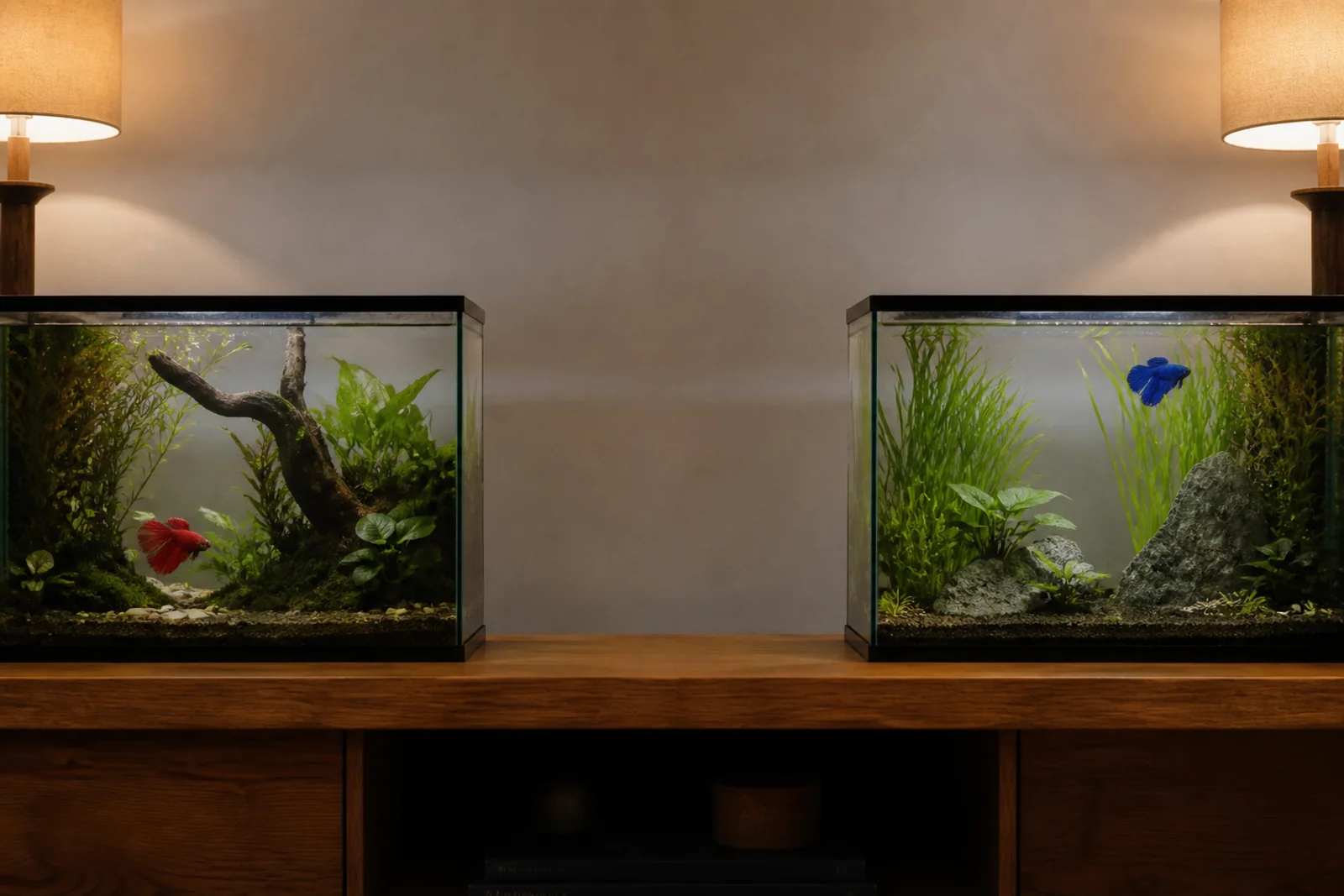
No. Two bettas in one tank is the single clearest rule in the hobby, and the reason is not temperament.
Why it is not negotiable
In the wild, a losing betta swims away. The water is large, the loser leaves, and both fish live.
In a tank there is nowhere to go. The display that would end a wild encounter becomes a fight that continues because the loser cannot exit, and it continues until one fish is dead or so damaged that infection finishes it days later.
The species was also selectively bred for exactly this response over a very long period. It is not a habit an individual fish grows out of, and it is not something a large enough tank fixes.
Every combination
| Pairing | Outcome |
|---|---|
| Two males | Fight to the death. Never |
| Male and female | Injury. Only in a supervised breeding attempt |
| Two females | Worst form of a sorority. No |
| Five or more females | A sorority. Advanced, fails often |
| One betta plus snails | Usually fine |
| One betta plus a shoal, 10 gallons plus | Sometimes, chosen carefully |
The male and female mistake
This one gets attempted because people reason that fighting fish fight members of the same sex.
They do not. A male will pursue a female relentlessly, and she has nowhere to recover. Breeders keep pairs apart, condition them separately, introduce them briefly with direct supervision and a way to separate them immediately, and remove the female straight after spawning.
That is what a managed pairing looks like. Two fish sharing a tank is not it.
Dividers
A divided tank is a compromise that can work, and it has conditions.
The divider must be secure at every edge, with no gap. Fish find gaps.
Each side must be adequate on its own. Dividing a five gallon gives you two unacceptable tanks rather than one good one. Divide a twenty, not a small tank.
Block the sight line. Two males staring at each other through a clear divider will display at it for hours a day, which is a sustained stress state with no resolution available. Plants against the divider, or an opaque panel, solves it.
Two heaters, or one placed so both sides are warm. Two feeding routines. In practice you are running two tanks that share a pane of glass.
The honest arithmetic
A second five or ten gallon tank with a heater and a sponge filter is not expensive. It is certainly cheaper than replacing a fish, and considerably cheaper than treating one that has been shredded.
If you want two bettas, buy two tanks. That is the entire solution and it works every time.
The one that lasted for weeks
Tanks that were peaceful for a month and then were not are a recurring story. Aggression frequently appears as fish mature, or when one decides the territory is worth defending, or after a rearrangement.
A period of calm is not evidence. Plan for the fight.
Where to go next
The tank mates guide covers what can share a tank with a betta and what cannot. The sorority article covers the group arrangement in detail, and the flaring guide covers what the display means when it appears.