
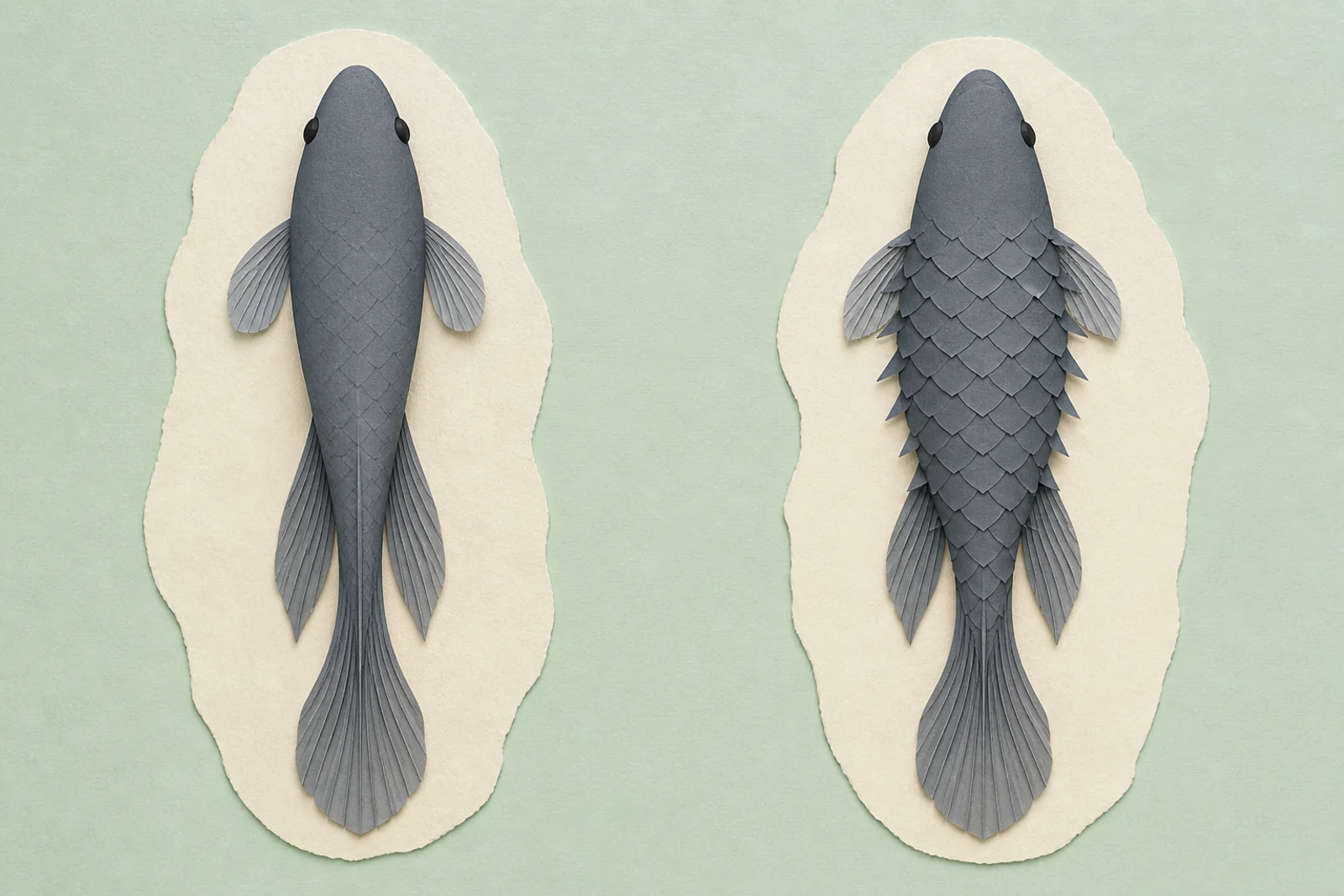
Dropsy is not a disease. It is what you see when fluid accumulates inside a fish because something internal has stopped working, most often the kidneys.
That distinction is the whole article. You cannot treat dropsy, because dropsy is the symptom. You can only treat whatever is causing it, and by the time it is visible that is usually well advanced.
Recognising it
Look down at the fish from directly above, not through the side glass.
In dropsy the body is swollen and the scales stand out from it, so the outline against the light looks like a pinecone. That specific pattern, seen from above, is what separates dropsy from every other kind of swelling.
Other signs that often come with it: a fish sitting low in the tank, pale gills, loss of appetite, eyes that protrude, and a general dullness.
What it is not
| What you see | Likely explanation |
|---|---|
| Rounded belly, scales lying flat | Overfed, constipated, or a female carrying eggs |
| Swelling on one side only | Injury, tumour, or an internal growth |
| Belly swollen after a treat | Simple overfeeding. Fast a day |
| Swollen with scales standing out | Dropsy |
Only the last line is dropsy. The first is extremely common and entirely benign, and mistaking one for the other causes a lot of unnecessary panic and a lot of unnecessary medication.
The honest prognosis
Most bettas showing pineconing do not recover.
The swelling appears once fluid regulation has already failed, which means organ damage has been accumulating for some time. Early and mild cases occasionally respond when an underlying infection turns out to be treatable. Advanced ones do not, whatever is added to the water.
We say this plainly because the alternative is worse. Owners spend weeks cycling through shop remedies on a fish that was never going to recover, and the fish spends those weeks dying slowly.
What to actually do
- Test the water. If ammonia or nitrite is present, that may be the cause and it affects every other fish in the tank too.
- Move the fish to a clean, bare, quiet hospital tank with a gentle heater.
- Keep the water pristine with small frequent changes.
- Contact an aquatic veterinarian. This is the one betta condition where a real diagnosis genuinely changes what happens next, and where a professional can tell you whether anything treatable is behind it.
- Consider humane euthanasia if the fish is suffering and not improving. A vet can advise on how, and this is a legitimate act of care rather than a failure.
Preventing it
There is no specific prevention, because there is no specific disease. What reduces the risk is everything that keeps organ stress low over a lifetime: stable warm water, ammonia and nitrite at zero, a varied diet in small portions, and not overfeeding.
Where to go next
The diseases pillar covers the conditions this gets confused with. The swim bladder guide covers a different kind of swelling, and the aquatic vet guide covers when and how to get professional help.