
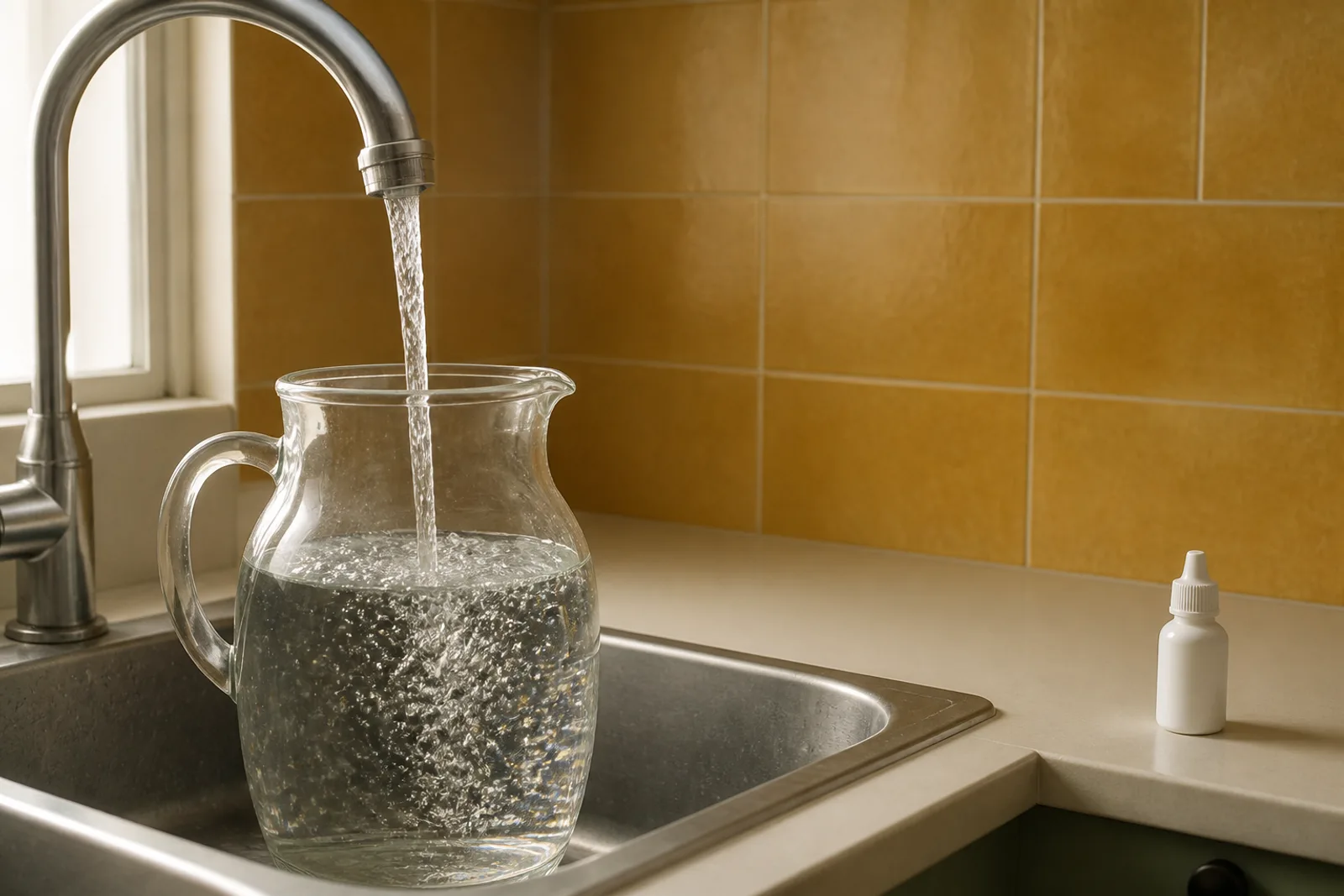
Treated tap water. That is the answer for almost everyone, and the more elaborate options are usually a step backwards.
Your betta was bred for generations in ordinary tap water at a commercial farm and then a wholesaler. It is not a wild-caught fish from a blackwater stream, and treating it like one causes problems rather than solving them.
What tap water needs
One thing: a dechlorinator.
Water suppliers add chlorine or chloramine to make water safe for you. Both are harmful to fish, and chloramine also releases ammonia as it breaks down.
Buy a conditioner whose label says it handles chlorine and chloramine. Most suppliers have moved to chloramine because it stays in the pipes longer, and the old advice about letting water stand overnight only works against chlorine. Standing water does nothing to chloramine at all.
Dose for the volume of new water you are adding, not the volume of the tank. A 25 percent change on a ten gallon needs conditioner for 2.5 gallons.
The three options compared
| Tap water | RO or distilled | Well water | |
|---|---|---|---|
| Minerals present | Yes | None | Usually plenty, sometimes too many |
| pH buffering | Yes | None, pH swings freely | Varies |
| Needs dechlorinator | Yes | No | No |
| Needs remineralising | No | Yes, always | No |
| Needs testing before use | No | No | Yes, every source is different |
| Cost per water change | Low | High | Low |
| Consistency | High | High | Varies with season and rainfall |
Why RO and distilled water fail on their own
They are too clean. Both have had dissolved minerals removed, and that has two consequences.
There is no carbonate hardness, so nothing holds pH in place. The value drifts, and small additions of anything push it around. A betta tolerates a wide pH range and does not tolerate a pH that moves.
There is no general hardness either, and fish need some dissolved calcium and magnesium. Water with none is not neutral, it is deficient.
Both are usable if you deliberately add minerals back with a remineralising product, or blend them with tap water. That is worth doing if your tap water has a genuine problem, and it is pointless work if it does not.
Well water: test first
Well water has one real advantage, which is that nobody has added chlorine to it.
It also has three common problems. Very high hardness, which is tolerable for a betta but will scale everything. High iron, which stains and clouds. High nitrate, which in agricultural areas can already exceed what you would accept in a tank before a fish has produced any waste at all.
Test a jug of it for pH, hardness and nitrate before you fill a tank. If nitrate is already high, well water is the wrong source and no amount of water changing will help, because the fresh water is bringing the problem in.
Which one you should actually use
Whatever comes out of your tap, treated, unless you have tested it and found a specific problem.
Chasing softer or purer water is the most common way keepers make their own chemistry unstable. A steady pH of 7.8 from the tap is better for the fish than a carefully engineered 6.8 that moves half a point between water changes.
Where to go next
The water parameters guide covers what each reading means. The testing walkthrough covers how to get a reading you can trust, which is worth doing on your tap water once before you decide anything.