
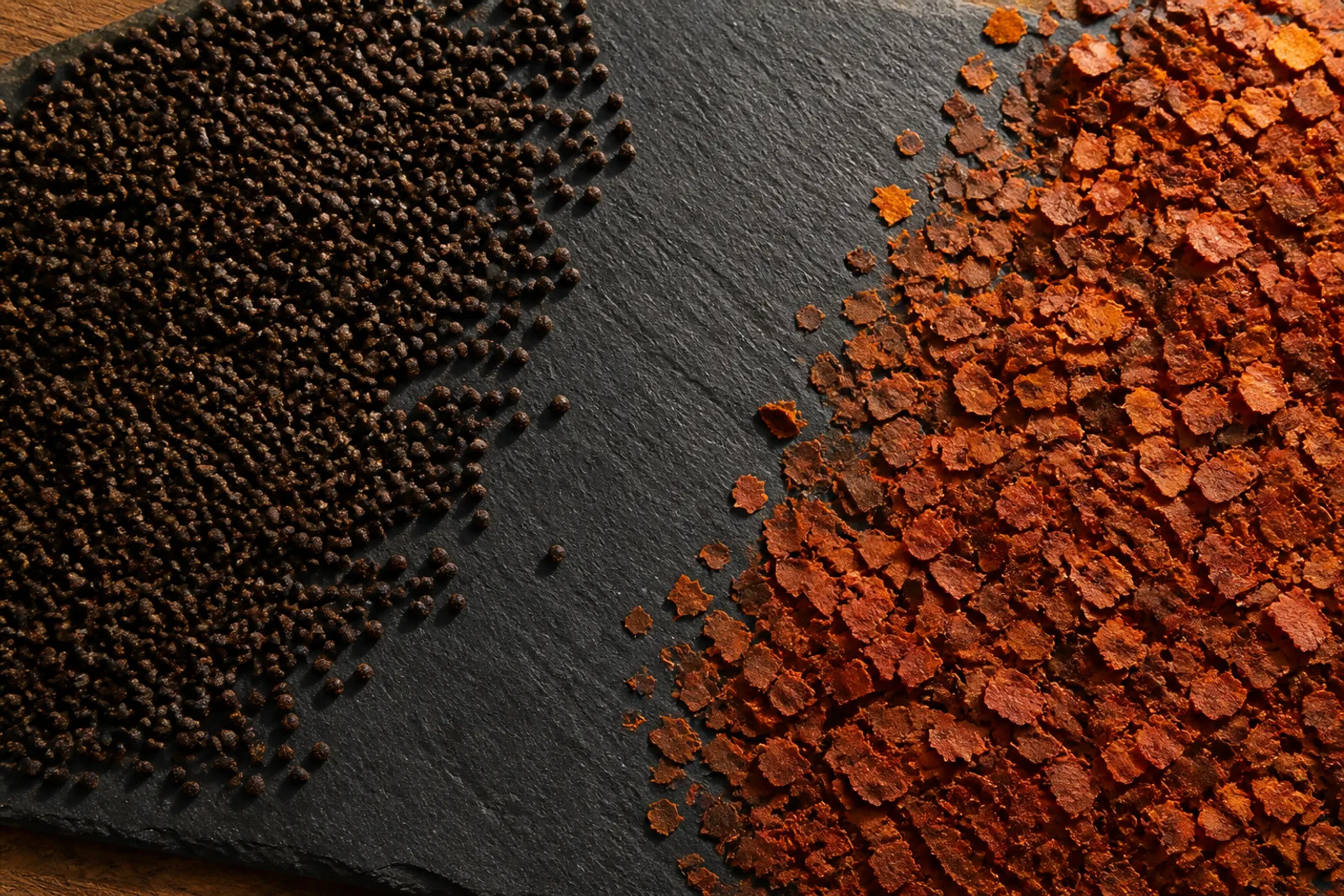
Pellets, for almost everyone. Not because flakes are nutritionally worse but because you can count pellets and you cannot count flakes.
That sounds trivial. Overfeeding is the most common feeding mistake by a wide margin, and countable food is how you stop making it.
The comparison
| Pellets | Flakes | |
|---|---|---|
| Portion control | Countable, exact | Guesswork |
| Holds shape in water | Yes, for a minute or two | Breaks up quickly |
| Reaches the substrate uneaten | Visible, easy to remove | Sinks into gravel invisibly |
| Suits a slow eater | Yes | Less so |
| Storage | Long, sealed | Degrades faster once opened |
| Availability of carnivore formulas | Wide | Narrower |
The row that decides it is the first one. Everything else follows from it.
Why counting matters
Uneaten food breaks down into ammonia. A betta needs a very small amount of food, and the gap between a correct portion and three times a correct portion is a few pellets, which is easy to get wrong by eye and impossible to get wrong by count.
Flakes disperse the moment they hit the water. Some are eaten, some drift past the fish, and some settle into the substrate where you will not see them rot.
Reading the label
Turn the container over and look at the first three ingredients.
Good leading ingredients are whole fish, fish meal, krill, shrimp or black soldier fly larvae. Poor leading ingredients are wheat flour, maize, soy flour or unspecified “cereal derivatives”. A grain-first formula is a cheap food for an omnivore, and a betta is not one.
Then check crude protein. Somewhere around 35 to 45 percent is what you want. Much lower and it is a community food wearing a betta label.
Ignore the picture on the front. It is not regulated in any useful way.
If flakes are what you have
They will do. Crush a very small amount between your fingers so you can see how much you are adding, drop it in a few flakes at a time, and stop the moment the fish slows down. Siphon anything that reaches the bottom during the next water change.
Switch to pellets when the container runs out.
Portion, in practice
Two to four small pellets, morning and evening, for an adult betta. Eaten within about two minutes.
One fasting day a week is common practice and does no harm. A betta’s stomach is roughly the size of its eye, which is a useful and slightly alarming thing to remember when the fish begs.
Where to go next
The feeding pillar covers the full diet including frozen and live foods, and the portion guide goes into how much and how often in more detail.